Showing posts with label Eid Namaaz. Show all posts

Tuesday, March 19, 2013

NAMAZ ( SALAH )

NAMAZ ( SALAH )

How do we perform Salaat (prayer):

When beginning salaat, men raise both hands. The tips of thumbs must touch the earlobes. Palms must be turned towards the Qibla. Saying of Allahu Akbar (Takbir) begins as the hands leave the ears and finish as they are folded under the navel.

NOTE: Women raise their both hands as high as their shoulders and say the takbir of beginning. Then they put their hands on their chest.

Watch video of Namaz Steps ( Namaz ka Tarika)


There are seven conditions for a salaat to be corrected.


1-Niyyat (intention)
2-Tahrima (To say Allah Akbar)
3-Qiyam (Standing)
4-Qiraat (Recitation of Quran by mouth gently)
5-Ruku (To bow)
6-Sajda (Prostration)
7-Qai'da-e- Akhira (Last sitting)

NIYYAT (intention) is made while saying the takbir at the beggining. It is permissible to make niyyat before that, too.

(I) To make niyyat for salaat means to intend in the heart to perform a particular Salaat - Its name, time, qibla, to wish to follow the imam (when performing salaat in jama'at) etc. Such as saying, "I pray two rakat (or as many required for that time) Fard (if its Fard or say Sunnat if its Sunnat or say Wajib if its Wajib or Say Nafil if its Nafil) of Fajr (or whichever Salaat it is) for Allah Ta'ala and facing towards the Ka'aba."

(ii) Knowledge only, that is, knowing what is to be done will not be niyyat.

(iii) The niyyat made after the takbir of beginning is not correct and that salaat is not acceptable.

(iv) When making niyyat for prayers that are fard or wajib, it is necessary to know which fard or wajib they are. For example, it is necessary to know the name of the fard and to say for instance, "To perform today's early afternoon prayer (Zuhr)," or, the time's fard." When performing the salaat of Eid or witr, it is necessary to think of its being wajib and its name.

(v) It is good (mustahab) but not necessary to make niyyat for the number of rak'ats (cycles).

(vi) When performing a sunnat the niyyat "To perform salaat will suffice."

(vii) When beginning to worship, saying orally only is not called niyyat. Worships done without niyyat are not acceptable in all four Madhhabs (Hanfi, Shaafi, Maliki and Hambali). Thus niyyat is done from the heart.

TAHRIMA
means to say "Allahu Akbar"

When beginning salaat it is Fard to say Tahrima. No other word to replace it is acceptable. If the takbir is said too long, like AAllah (with AA instead of one A) in the beginning or Akbaar (with aa instead of one a) at the end, salaat will not be accepted. If 'Takbir' is said before the Imam, salaat will not have started.

QIYAM means to stand.

(I) When standing, the two feet must be four finger's width apart from each other.

(ii) In Fards,Wajibs and in the sunnat of Fajr salaat Qiyam is Fard. It means a person who is healthy but performs the above mentioned salaat while sitting, is not acceptable, He must perform all of the mentioned Salaats with qiyam for his salaat to be accepted.

(iii) He who is too ill to stand should perform salaat sitting, and if too ill to sit he should lie down on his back and performs it with his head (by moving,nodding his head,etc,). A pillow must be put under his head so that his face will be towards the qibla instead of towards the sky. He bends his knees, so that he will not stretch his legs towards the qibla.

(iii) As qirat is wajib to recite Surah Fatiha and to also recite a sura or three ayats in every rak'at of sunnats and of witr prayer and in the first two rak'ats of the fard.

(iv) In the fard (prayers of salaat that are obligatory), it is wajib to say the Fatiha and the other sura at the two first rak'ats. Additionally, it is wajib to say Surah Fatiha before the sura. Furthermore, it is wajib to say the fatiha once in every rak'at. If one of these five wajibs is forgotten, it is necessary to make sajda-e-sahw.

(v) In the third and the fourth rak'ats of the fard, it is sunnat for the Imam as well as for a person who performs salaat individually to say the Fatiha. [Ibni Abidin shami, p 343].

(vi) A settled (resident) person who follows a traveling one stands up when the imam makes the salam after the second rak'at,and performs two more rak'ats,but he does not make the qirat. That is, he does not say the Fatiha or the other sura. He does not say any prayer as if he were praying salaat behind the imam.

(vii) In every prayer of salaat except Friday prayer and Eid prayer, it is sunnat for the imam that the sura he says in the first rak'at (after the Fatiha) be twice as long as the one he says in the second rak'at.

(viii) It is makruh to say a sura in the second rak'at three ayats longer than the sura said in the first rak'at.It is always wajib to read the suras or ayats from the Qur'an.

(xi) A person who is too ill to stand, or feels dizzy or has a headache or toothache or pain in some other part of his body or can not control wind or bleeding when he stands should perform salaat sitting.

QIRAT: Means to read (recite) by mouth gently. Reading gently means to read only as loud as can hear yourself. (I) The recitation is called Jahri, that is, loud if its heard by people who stand on each side of the recitor. (ii) It is fard to say an ayat (verse) of the Quran while in Qiyam (standing) in every Rakat and it must be in the order as they are written in the Quran. For example one cannot recite Surah Naas in first rakaat and Surah Ikhlas in second.

RUKU: After the sura you bend for Ruku whilst saying takbir. (I) In ruku men open their fingers and put them on their knees. They keep their back and head leveled in ruku. Also the arms and legs must be straight and then you say, "Subhana Rabbiyel Azeem" at least thrice. (ii) If the imam raises his head before you have said it three times you must raise your head too.  You must not wait to complete the recitation thrice. In Ruku women do not open their fingers, they do not keep their head and back level, nor their arms and legs straight.

It is sunnat, for the imam as well as a person who is performing salaat alone, to say 'Sami Allahu liman hamidah' while straightening up from Ruku. The Jama'at does not say it. Right after saying it (if praying alone) or upon hearing the imam recite it (if with jama'at), you must say 'Rab'bana lakal hamd', and stand upright. Then, saying takbir (Allahu Akbar) start to kneel down for the Sajdah. First place the right knee and then the left knee, followed by the right and then left hand on the floor. Finally, the nose and the forehead bones are placed put on ground.

SAJDAH
(prostration)

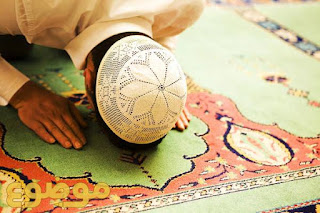
(i) In Sajdah, fingers must be closed (no gap in between fingers), pointing towards the qibla in line with the ears, and the head must be between hands. It is fard to put the forehead on something clean, such a clean stone, clean ground, clean wood or clean cloth and it is wajib to put the nose down too. It is not permissible to put only the nose on the ground without a good excuse. It is makruh to put only the forehead on the ground. Thr nose should be pressured enough so that the bone of nose feel the ground, its very important to keep in account when perfoming salat on a soft carpet.

(ii) In sajda, you say, 'Subhana Rabbiyal A'la' at least thrice.

(iii) It is fard to put two feet or at least one finger of any foot on the ground. If both the feet are not placed on ground, salaat will be annulled and not be accepted.

(iv) It is sunnat to bend the toes and turn them towards the qibla. (v) Men must keep their arms and thighs away from their abdomen.

(vi) Sajda must be done on the ground on condition that you will press on them until you feel their hardness, that is until your forehead cannot move downward any more. Same applies for the nose. Special precaution is required on this issue when peroforming salat on a carpet.

(vii) It is written in 'Halabi': "When going into sajda it is Makruh-e-Tehrimi to pull up the skirts of your loose long robe or your trousers, and it is Makruh-e-Tehrimi to fold them before beginning salaat. It is Makruh-e-Tehrimi to perform salaat with folded sleeves, cuffs or skirt." Special attention is needed on this issue for the people of India and Pakistan who wear Shalwar and Kurta. If pulled or folded one must repeat the Salat.

(viii) It is Makruh to perform salaat with a bare head because of laziness or without realizing the importance of performing salaat with a covered head. For, not to cover one's head means to disobey the ayat: "Take your ornamented clothes and cover yourself for salaat!"
(xi) It is sunnat to wrap a turban (Imama) around the head whether in white or black color as Rasulullah Salallahu Alaihi Wasallam used these colours or any other color.

(x) Allama Ibne Abidin Shami Rehmatullahi Ta'ala Alaih said, "Direction towards qibla is fard for salaat. That is, salaat is performed by turning towards the direction of the Ka'aba. Salaat is performed for Allah. Sajda is done for Allah Ta'ala only, not for the Ka'aba. One who makes sajdah for the Ka'aba becomes a disbeliever."

QAI'DA-I-AKHIRA:
Means sitting in the last rak'at. it is fard to sit as long as it takes to say the Athiyyat, "Atthayyato Lillahe Wassalawato Wat Tayyebato Assalamu Alaika Ayyohan Nabiyo Wa Rehmatullahe Wa Barakatoh Assalamu Alaina Wa Ala Ibadillahis Sualaiheen Ashadu An La ilaah illal Laho Wa Ashadu Anna Mohammadan Abdohoo Wa Rasooloohoo" When sitting, men put their left foot flat on the ground with it toes pointing towards the right. They sit on this foot. The right foot should be upright, with the toes touching the ground and bent and pointing towards the qibla.

NOTE 1: Women sit by Tawarruk. That is, they sit with their buttocks on the ground. Their thighs should be close to each other. Their feet should jut out from the right.

NOTE 2: When you reach at Ashadu An La raise your index finger of your right hand upward facing about 45 degrees by closing the fist, and drop it back and spread the hand to its original position at illal Laho.

KHUROOJ BI SUN'EEHI:
To signify the completion of prayer by word or action. It means to finish out prayer by saying or doing something. Salaat is completed by saying, "Assalamo Alaikum Wa Rehmatullah" First by moving head towards right and saying it, then towards left and saying it.

PRAYER AFTER THE SALAAT:

(i) It is mustahab (good) for the imam to turn right or left or towards the jama'at.

(ii) It is stated in a hadith, 'If a person says, "Astaghfirullah Al'azim-il-llazi La ilaha illa Huw-al-hayy-ul-qayyuma Wa Atubu ilayh", after every prayer of salaat, all his sins will be forgiven.

(iii) Imam and the followers raise their hands as high as their chest and pray (Dua) for themselves and for all muslims. A hadith declares, 'Prayers (Dua) sent after the five daily fard will be accepted.' (Tirmidhi). But the prayers (Dua) must be done with a vigilant heart. Not with fingers turned towards the qibla, arms not opened apart in the right-left direction, arms too close to each other, too far forward etc.

(iv) While saying Dua, the fact is that it is mustahab (good) to say salaat and salaam upon RasoolAllah (sallallahu alaihi wasallam),

(v) After making your Prayers (Dua), it is sunnat to rub the hands gently on the face.

THE DIFFERENCE BETWEEN MEN AND WOMEN PERFORMING SALAAT:

(i) When beginning to perform salaat, a woman raises both hands up to the level of her shoulders. While standing she puts her right hand on the left hand. However, she does not grasp her left wrist the fingers of her right hand. She puts her hands on her breast. While making ruku, her hands are placed on the knees, but do not grasp them. She keeps her fingers close together. She does not keep her legs straight, nor her back level. While making sajda, she lowers herself, bringing her arms to her side while she keeps her abdomen placed over her thighs. She sits on the buttocks, her legs inclined towards right.

(ii) A woman cannot be imam for men. If they follow a man as imam, they should be in last line of the jama'at.

(iii) While performing salaat in jama'at, if a woman stands besides or in front of a man, the man salaat will be Fasid (nullified).

PAINFUL TORMENT AT THE TIME OF DEATH, IN GRAVE, ON THE DAY OF JUDGEMENT AND IN HELL.

A hadith shareef, quoted in the book 'Qurratul'uyun,' declares, "If a person does not perform salaat though he has no good excuse, Allah ta'ala will give him fifteen kinds of punishment. Six of them will come in the world, three will come at the time of death, three will come in the grave, and three will come when rising from the grave. The six plagues in the world are:

1-Person who does not perform salaat will not have barakat {blessings} in his life.
2-He will not have the beauty afforded to those who are loved by Allah ta'ala.
3-He will not be given reward for any good he does.
4-His supplications (duas) will not be accepted.
5-No one will like him.
6-Supplications that (other) Muslims invoke for him will do him no good.

Kinds of torment he will suffer when dying are:


1-He will expire in an abhorrent, unsightly, repugnant manner.
2-He will die hungry.
3-No matter how much water he has, he will die with painful thirst.

Kind of torment he will suffer in the grave are:


1-The grave will squeeze him. His bones will intertwine.
2-His grave will be filled with fire, which will scorch him day and night.
3-Allah Ta'ala will send a huge snake to his grave. It is not like terrestrial serpents. It will sting him at every prayer time each day. It will never leave him alone any moment.

Kinds of torment he will suffer after rising are:


1-Angels of torment will drag him to hell will never leave him alone.
2-Allah Ta'ala will meet him with wrath.
3-His accounts will be settled in a very vehement manner, and he will be flung into hell. (May Allah save us) On the other hand, we see that one who performs salaat five times a day his sins are forgiven. As it is stated in the hadith, RasoolAllah (salallahu alaihi wasallam) asked his companions: "If there were a river in front of one's house and if he washed himself in this river five times every day, would there be any dirt left on him?" We (Jabir bin Abdullah and other sahaba present there) said, "No, O Rasulallah." Allah's most beloved Prophet (salallahu alaihi wasallam) said, "Likewise minor sins of those who perform the five daily prayers are forgiven." Ibn Jawzi (may Allah be pleased with him) wrote in his tafsir Elmugni: Abu Bakr Siddiq (may Allah be pleased with him) said that, "When the time of a daily prayer of salaat comes, Angels say, 'O the sons of Adam, stand up! Extinguish the fire prepared to burn human beings by performing salaat.
Method of praying Qaza Salahs Quickly

If someone has missed Salahs in their account. Either one time's or of many years, they must pray their Qaza as soon as possible. Salah is a Fard and not forgiven. On the day of judgement Salah will be the first thing asked about.

For the people who have many years of missed Salahs. There is a way to pray them quickly. Following instructions have four exceptions and has all Fards and Wajibs for a complete Salat. Please pray your Qaza as soon as possible. Even of you could pray one days Qaza Salahs every day which are only 20 rakahs (3 wajib witr), please do it. It only takes few mins to perform 20 rakahs according to the following instructions.

1) In Ruku and Sajdah instead of reciting "Subhaana Rabbiyal Azeem" and "Subhaana Rabbiyal A'la" three times, say it only once. But make sure do not leave Ruku posture untill the Meem (M) of Azeem has been said properly. Similarly do not leave the posture of Sajdah until Ala has been said completely. Just make sure to say these Tasbeehaat properly and do not rush.

2) In third and four Rakah of Fard Salah instead of reciting the whole Soorah Fatiha say "Subhan Allah" three times and go to Ruku, . Make sure "Subhan Allah" has been recited three times properly, do not rush. This exeption is only for Fard. In third rakah of Witr it's a must to recite full Soorah Fatiha followed by at least three ayahs of Quran or a soorah (as we usually do in first and second rakah).

3)
In last Qaidah (when we sit for Attahyyat) before Salam, after Attahyyat instead of full Durood and Dua just say, "Allah Humma Salle Ala Sayedena Mohammad Wa Aalihi", then finish the Salat with Salam. Dua is not a must here.

4) In Witr, instead of full Dua-e-Qunoot just say "Rabbigh Fir Lee" one or three times.

(Fatawa Rizvia, Part 3, Page 622)


Salatul Tasbih - For forgiveness of All Sins

Benefits of Salat-Ul-Tasbih

Our Beloved Prophet Mohammed (Sallallaho Alihiwa Sallam) said to his uncle Sayyiduna Abbass (may Allah be pleased with him), "Oh uncle, Shall I not give you? Shall I not grant you? Shall I not award you? Shall I not do mercy on you? When you do 10 things Allah will forgive your sins: of the future and of the past; new and old; those you have forgotten and those you did knowingly; big and small; hidden and revealed."

Then he (Sallallaho Alihiwassallam) explained the taught the way to pray Salatul Tasbih and then said if you can pray this salah once a day, if you can not pray once a day then every Friday, and even if this is not possible then once a month and even if this is not possible then once a year and even if this is not possible then at least once in a lifetime (Abu Dawood & Tirimzi)

How to perform Salatul Tasbih

This salaat (namaz) is offered in four rakat at a time and can be read in any part of the day and night besides Zawal and Sunrise and Sunset makrooh times, keeping in mind the forbidden times for performing Salat (namaaz). But is is preferred before Zuhr (Fatawa Alamgeeri)

The Tasbih to be read in Salaat-Ul-Tasbeeh:
" Subhaan Allahi Wal Hamdulillahi Wa Laa ilaha illal Laahu Wallahu Akbar "

Method:


Goal is to recite above Tasbih 300 times in Four Rakah with the following method.
In the first rakaat, after reading Sana "Subhaana Kallahumma...", read the tasbih 15 times.

Now recite "Aoozubillah...", "Bismillah...", Then read sura Fatiha and a Surah or minimum of three small Ayayhs then read the tasbih 10 times again.

Go to ruku saying Takbeer (Allah Hoo Akbar), after reciting "Subhaana Rabbiyal Azeem" minimum of three times read the tasbih 10 times in Ruku.

Saying "Samee Allahu Liman Hamidah Rabbana Lakal Hamdh" get up from ruku to qiyam position.
Now read the tasbih 10 times.

Go to Sajdah saying Takbeer (Allah Hoo Akbar) and after reciting "Subhaana Rabbiyal A'la" minimum of three times read the tasbih 10 times in Sajdah.

Now go after first Sajdah go to Jalsa (sitting position) saying Takbeer (Allah Hoo Akbar). Sitting in Jalsa read tasbih 10 times.
Go to sajda again saying Takbeer (Allah Hoo Akbar) and after reciting "Subhaana Rabbiyal A'la" minimum of three times read the tasbih 10 times in Sajdah again.

Get up to begin 2nd rakat saying Takbeer (Allah Hoo Akbar).

Do rakah #2 in same fashion, but before reading Bismillah "Bismillah...", and Surah Fatiha, read the tasbih 15 times. Follow the rest as you did in first Rakat.

After second Sajdah of Second Rakat sit in Qaidah Oola (first sitting) read Attahiyat, Durood and Dua then get up for 3rd rakaat without saying Salam.

Begin third Rakat, just like the first Rakat, with Sana "Subhaana Kallahumma...", read the above tasbih 15 times.

Follow the rest as you did in first Rakat untill you sit for Qaidah Akihra (last sitting) after second sajdah of fourth Rakah.
In Qaidah Akihra Attahiyat, Durood, Dua finish Salah with Salam.

Special notes for Salat-Ul-Tasbih:


1) Do not count loudly. It will break Salah

2) Do not count on fingers or by holding a Bead Tasbih in hand. It is Makruh.

3) You may count by pressing the fingers as a reminder. For example if you are in Ruku. You me press pinky of your right hand first for the first count, then the finger next to it for second count, then the middle finger for third count, following this method untill you reach the pinky of left hand will give you an exact count of ten. Use the same method in Qayam, Sajdah and Jalsa.

4) If missed a count then make it up in the next posture. For example if forgot to recite Tasbih after Surah in Qayam. Then you may recite Tasbish 20 times instead of 10 in Rukuh after "Subhaana Rabbiyal Azeem". Missed Tasbih cannot be recited in Qayam after ruku and Jalsa between Sajdah. If you missed the Tasbih in Ruku then recite 20 in the first Sajdah instead of the Qayam after rukuh. Similarly if missed the Tasbih in first Sajdah then do not make it up in Jalsa. Instead recite missed tasbih in the second Sajdah. If Tasbih has been missed in last sajdah of second or fourth Rakah then you can recite the missed ones before Attahiyat in Qaidah.

5) If you miss a wajib in Salah and have to do Sajdah Sahaw. You dont have to recite Tasbih in Sajdah sahoo, since the 300 count has been estalished. But if you had missed Tasbih in any of the postures and remeber it now. Then you may recite the missed Tasbih in Sajdah Sahaw now.

6) It is preferable to recite after Surah Fatiha Sura Takathuur in the first raka’, Surah Wal A’sr in the second raka’, Surah Kaferoon (qul ya aiyuhal Kafiroon) in the third and Surah Akhlas (Qul hu Allah-hu ahd) in the fourth raka’. If one does not remember these surah they can recite the ones they prefer.

May Allah accept this dua’ (supplication) for the sake of the trustworthy PROPHET MOHAMMED (Allah’s Grace & Peace be upon him)

Tuesday, August 2, 2011

How to Pray Namaz

How to Pray Namaz

With Wuzu, face towards the Qibla and stand so that there is a gap of four fingers between your feet.
Take each hand to each ear and touch the lobes of the ears with the thumbs and leave the rest of the fingers in their normal state, don't join them together or spread them apart.

Face the palms of the hands towards the Qibia and your sight is to look at the sijdah. Then make a firm intention in your heart as to which Namaz you are praying and while saying 'Allah-o-Akbar' lower your hands and join them below the naval. The way to join the hands is to have the palm of the right hand on top of the back of the left hand wrist, keep the middle three fingers straight and circle the left wrist with the thumb and the little finger firmly grasping the hand.

Then pray 'Sana' meaning Subhanakallah Humma Wa Bihamdika Wa Tabarakasmuka Wa Ta'ala Jadduka Wa Laa ila'ha Ghairuk" . Then pray Ta'awwuz meaning "A'oozu Billahi Minas Shaitaanir Rajeem" and then pray Tasmee'a meaning "Bismillah' ir'rahman'ir' Raheem" .

Then pray the whole of the 'Alhamdo' Surat and say 'Aameen' quietly. After this, pray any Surat or three ayats or one ayat which is equivalent to three small ayats.

Then whilst saying Allah-o-Akbar go into the Rukooh. Grasp the knees with the hands and spread your fingers over the knees. Keep your back straight and your head level with your back and make sure that you are not too far up or kneeling to low down and keep your sight on your feet and pray at least three times "Subhana Rabbi'al Azueem' and then pray this whilst standing up 'Sami Allahu Liman Hamidah' and if you are praying Namaz alone then also say 'Allahumma Rabbana Walakal Hamd' and then while saying Allah-o-Akbar go into the Sijdah.

The way to do this is to first put your knees on the ground, then put your hands at the side of the place where your are going to put your head and then place your head by first placing your nose on the ground and then your forehead and then press hard on your nose. Look towards your nose and keep your elbows up so that they don't touch the ground and leave a gap between your armpits and make sure that there is a gap between your thighs and your stomach. Place all your toes so that their tips are pointing towards the Qibla and their bases are flat on the ground. Keep your hands flat and have your fingers pointing towards the Qibla. Then pray at least three times 'Subhana Rabbi al A'ala'.

Then lift your head up while saying Allah-o-Akbar with first lifting your forehead then your nose then your face and then your hands. Keep your right foot upright and lay your left foot flat and sit on it firmly. Place your hands on your knees with the finger tips pointing towards the Qibla and the palm of your hands flat near your knees and the base of the .fingertips laid flat at the end of your kneecaps.

Then whilst saying 'Allah-o-Akbar' go back into the Sijdah and this is done in the same way as the first one. Then stand up by placing your hands on your knees and putting pressure on your knees and legs stand upright, don't put your hands on the ground to assist you to stand up. Now pray only 'Bismillah'ir' Rahmaan'ir' Raheem' and then Alhamdo and another Surat and as before perform Rukooh and Sijdah, and when getting up from the second Sijdah leave your right foot upright and lay your left foot flat and sit upright. And pray •AttahiyyaatuLillahi Was Salawato Wattayyibatu Assalamu Alaika Ayyuhannabi 'o 'Warahmatullahi Wabarka'tuhu Assalamu Alaina Wa'ala'Ibadillahis Sa'liheen, Ash'had'u'un La ilahaillallahu Wa Ash'hadu Anna MuhammadunAbd'uhu Wa Rasooluh', This is known as Tashahhud.

When you are reaching La'ilaha make a circle in your right hand by joining the thumb with the middle finger and curl the small and it's adjacent finger with the middle finger and on the word La lift your index finger but don't move side to side and when you reach 'illallahu' straighten your hand back to normal. Now if you have more than two Ra.kats to pray then stand back up and pray more Rakats, but for a Farz Namaz there is no need to join another Surat after Alhamdo and then continue and when you reach your last Qaidah (sitting position) pray Tashahhud and then pray the DuroodSharif called Durood-e-lbrahim'Allahumma Salleh Ala Sayyidina Muhammadin Wa'ala' Aale Sayyidina Muhammadin Kama Sallaiyta Ala Sayyidina Ibraheema Wa' Ala Aale Sayyidina Ibraheema InnakaHameedum Majeed -Allahumma Baarak Ala Sayyidina Muhammadin Wa' Ala Aale Sayyidina Muhammadin Kama Baarakta Ala Sayyidina Ibraheem Wa' Ala Aale Sayyidina Ibraheema Innaka Hameedum Majeed' After this pray'Allahumag Firii Wali Wale Dayya Wal Ustaad'e Wal Jamee'il Mu'mineena Wal Mu'meenat Wal Muslimeena Wal MuslimatAI'Ahya'eMinhum Wal Amwaat'e Innaka MujeebudDa'waatBirahmatikaYa Ar'hamarr'ahimeen' or pray another Dua-e-Ma'soor or pray 'Allahumma Rabbana Aatina Fid DuniyaHasanatawWafil Akhirati Hasanataw Wa QinaAzaabanNaar' Make sure you pray this by starting it with 'Allahumma' and then turn your head towards your right shoulder and say'Assalamu Alai'kumWarah'matullah' and then turn your head towards your left shoulder and repeat the same words again.

The Namaz has now finished, so raise both your hands and pray any Dua for example'Allahumma Rabbana Aatina Fid Duniya Hasanataw Wafil Akhirati Hasanataw Wa Qina Azaaban Naar' then rub your hands over your face. This is the method for an Imam or a male praying Namaz on their own.

If however, you are a Muqtadee meaning praying in congregation (Jamaat) and behind an Imam then don't perform Qiraayat meaning don't pray 'Alhamdo' or a Surat, whether the Imam is praying loudly or quietly. Qiraayat is not allowed in any Namaz if it is being prayed behind an Imam.

If the Namazee is a female then at the Takbeer-e-Tahrima she should lift her hands only upto her shoulders and then place her left hand on her chest and the right hand on top of it. When performing Rukoo she should only bend a little so that her hands reach her knees and she should not put pressure on her knees and keep her fingers tightly together and not to straighten her back like males.

When performing Sijdah she should crawl up and perform Sijdah so that the arms are joined with the sides, her stomach is joined with her thighs and her thighs are crawled up with her shins and her feet are pointing outwards and are flat. In Qaidah she should have both her feet pointing outwards towards the right and are flat. She should sit on her left buttock and keep her hands in the middle of her thighs.

Monday, May 16, 2011

Importance of Friday prayers (Jumma Salat) in Islam | Jumma ke Ehkaam

Importance of Friday prayers (Jumma Salat) in Islam | Jumma ke Ehkaam

Juma ka din hum Musalmano ke liye EID jaisa darja rakhta hai.
Juma ke din ki hui ek neki ka ajr 70 guna badh kar milta hai.

Aur ek burai ka Gunah bhi 70 gunah badh kar milta hai.

1. Juma ko gusal zaroor kare. Huzur saw ne farmaya"Jis shakhs ne JUMA ko (paak hone ke bawjood sirf sawaab ki niyat se) gusal kiya to uske agle pichle sab gunah maaf ho jate hain "Ek dusri hadees me hain ki "Juma ka Gusal baalo ki jadon me se bhi Gunaho ko bhi nikal phekta hai"

2. Juma ko Kasrat se Durood padhe. Kyunki Juma ko farishto ki ek jamaat sirf isi kaam me hoti hai ki Huzur saw per padha jane wala DUROOD aap ke paas pahuchati hai. Sabse afzal DURROD IBRAHIM hai.

3. JUMA ko SALAAT-ut-TASBEEH ki namaz bhi padhe. Huzur saw ne farmaya ki "Ye namaz jo padhta hai uske agle-pichle, chote-bade, jaan bijh kar kiye hue aur anjane me kiye hue, sageera aur kabeera, sab Gunah maaf ho jate hain." Aur JUMA ko sab amal ka sawaab 70 guna badh kar milta hai to is ki Fazeelat aur badh jati hai.

4. JUMA ko ASR ki namaz ke baad jo shaks ye DUROOD 80 padhega "ALLAHUMMA SALLI ALAA MUHAMMADIN NABIYIL UMMIYEE WA ALAA AALIHI WASALLIM TASLEEMA" to uske 80 saal ke Gunah maaf honge aur 80 saal ki Ibadat uske aamaal-naame me likhi jaegi.

5. JUMA ko SURA KAHF padhe, Huzur saw ne farmaya "Jo shakhs Juma ko Sura Kahf padhega to agle hafte tak uske saath ek noor rahega jo KAABE tak pahuchta hoga aur agar is dauran DAJJAL nikal aaya to uske fitne se mahfooz rahega" Ek dusri Hadees me hai ki "Jo shakhs JUMA ko SURA KAHF padhega to agle hafte tak ke uske Gunaho ka kaffara ho jaega"

ALLAH hum sab ko tofiq de aur zyada se zyada DEEN ki mehnat karne wala banaye.

Jumma Namaz Q&A


There are seven conditions for a salaat to be corrected.

1-Niyyat (intention)
2-Tahrima (To say Allah Akbar)
3-Qiyam (Standing)
4-Qiraat (Recitation of Quran by mouth gently)
5-Ruku (To bow)
6-Sajda (Prostration)
7-Qai'da-e- Akhira (Last sitting)

Also Read How to Pray Jumma Namaz

Wednesday, September 16, 2009

How is Eid-ul-Fitr celebrated after Ramadan

How is Eid-ul-Fitr celebrated after Ramadan


Praise be to Allah (SWT) for the blessings of faith, and may His peace and blessing be upon the seal of the Prophets, Mu­hammad Bin Abdullah, his family and companions until the end of time. The believer should be cognizant of the fact that the month of Ramadan is nearing are end and its departure is imminent. Ramadan may be a witness for or against you. Who­ever is blessed to fill it with faith and good deeds should thank Allah for the honor, and must be assured of reward in the Hereafter. For Allah (SWT) will never deny a soul his or her just and complete reward. Whoever fills it with unseemly acts should return to Allah in repentance, which He has promised to accept.


How to perform Eid-ul-Fitr Namaz and Nawafil Namaz (Salat) on day of Eid-ul-Fitr

How to perform Eid-ul-Fitr Namaz and Nawafil Namaz (Salat) on day of Eid-ul-Fitr

Steps for Performing Eid-ul-Fitr Namaz There are six extra Takbeers in Eid Namaz Three befor...
Read More


Allah (SWT) has mandated acts of worship at the end of Ramadan in order to assist us in our desire to express our love for Allah, to strengthen our faith and increase the weight of our deeds. He mandated fast breaking alms (Zakatul Fitr); legis­lated glorification and exaltation of Allah, (Takbeer) on the eve of 'Eid beginning from sunset until the time of 'Eid.

He (SWT) stated: “He wants you to complete the prescribed pe­riod and to glorify Him in that He has guided you and perchance you shall be grateful” (Al-Qur'an, 2: 187)

The takbeer goes like this:
“Allahu Akbar, Allahu Akbar, laa ilaaha illallah, wallahu Akbar Allahu Akbar wa lillahil hamd.”

Men will say this Takbeer aloud in Masaajid,
market places, and in homes affirming Allah's glory and publicizing His mercy upon them. Women will express their Takbeer silently as they are commanded to conceal their voices. Allah (SWT) legislated `Eid prayer. It culminates in the remembrance of Al­lah (SWT).

The Messenger of Allah (saas) commanded his fol­lowers, men and women, to fulfil this `Ebadah and His com­mands must be obeyed by all, as Allah (SWT) said:
“O ye who believe, obey Allah, and obey the Messenger, and make not vain your deeds.”
(Al Qur'an, 47: 33)

He commanded women to leave their homes and attend 'Eid, whereas their praying at home is at other times more preferable and better.

In a Hadith related by Umm `Atiyah, she said, “The Messenger of Allah commanded us to leave our homes for `Eidul Fitr and `Eidul-Adha prayers, includ­ing mature, menstruating women and virgins. As for the menstruating women, they should keep away from the place of worship but should participate in good deeds and du`a. `Umm `Atiyah interrupted: ‘O Messenger of Allah, some of us do not have the outer garment (Jal­bab)!’ He replied: ‘She may borrow it from her friend.’” (Muslim and Bukhari)

It is recommended to eat a few dates in odd numbers before leaving for `Eid in `Eidul Fitr, in accordance with the report from Anas Bin Malik (raa), who said: “The Messenger of Allah (saas) will not leave for `Eidul Fitr until he eats some dates in odd numbers.” (Ahmed / Bukhari)

It is recommended to go to the `Eid site walking instead of rid­ing unless the place is far or the person is unable to walk due to age or illness. Men should wear their best clothes, but should avoid silk and gold. Women should wear modest and decent long dresses, and avoid flashy or immodest outfits and per­fumes in their outing for `Eid. `Eid prayer should be observed in the most humble and devoted manner.

One should praise Allah often and seek His mercy and should remember the ultimate gathering in the Hereafter (Al Maqamul a'Azam). He should be cognizant of the fact that there is ine­quality and disparity among the ranks of the believers on `Eid day as there will be disparity in ranks among the believers in the Hereafter.

Allah (SWT) stated: “See how We have bestowed more on some than on others, but verily the Hereafter is more in rank and gradation and more in excellence.” (Al-Qur'an, 17:21)

One should be jubilant that he or she is blessed to fast during Ramadan and has been able to observe prayers, recitation of Al-Qur`an and giving of Zakaat. These acts are better for us than this world.

Allah (SWT) says: “Say in the bounty of Allah and in His mercy, in that let them rejoice; that is better than the wealth they hoard.” (Al-Qur'an, 10: 58)

Indeed, if the `Ebadah of this Ramadan is finished and the `Eid prayer is completed the `Ebadah of the believer will not finish until death.

Allah (SWT) states: “O ye who believe, fear Allah as He should be feared, and die not except in a sate of Islam” (Al-Qur'an, 3:102)

Also, “And serve thy Lord until there comes unto thee the Hour that is certain.” (Al-Qur'an, 15: 99).

The Messenger of Allah said: “When the servant of Allah dies, his deeds are cut off.”

So the service to Allah is continuous until the end of life. The end of Ramadan does not mean the end of fasting. There is the highly recommended fasting of six days in Shawwal, and three days sunnah fasting in every month, as well as on Mondays and Thursdays, and fasting most of Shaban and Muharram. If Ramadan is over, night prayers are not. Praise be to Allah, this remains a sunnah of the Messenger (saas) every night of the year forever.

In a Hadith by Mughirah bin Shu'bah (raa) he said: “The Messenger of Allah (saas) regularly prayed at night until his feet swelled'. He was asked, ‘Why (this hardship)?’ He responded: ‘Why shouldn't I be a ser­vant who expresses his gratitude this way.’” (Bukhari)

In another Hadith related by Abdullah bin Salaam (raa), the Messenger said:
“O people if you disseminate salutations (salaam) among your ranks, feed those who need to be fed and maintain the family ties and pray at night while people sleep, you will enter paradise with peace.” (Tirmidhi)

The Sunnah prayers (Rawatib) before or after the five daily prayers are 12 raka'aat: four before Zuhr (Noon prayer), and two after; two raka'aat after Maghrib (Evening prayer); two raka'aat after `Ishah (Night prayer), and two raka'aat before Fajr (Morning prayer).

In a Hadith related by Umm Habeebah (raa), she say: “I heard the Messenger of Allah (saas) said: ‘Every ser­vant who observes twelve raka'aat of supererogatory prayers other than the obligatory prayers, Allah (SWT) will build for him a house in paradise.’ ”

In another version: “Whoever prayed twelve raka'aat (of supererogatory prayers), day and night, Allah (SWT) will build with them a house for him in paradise.” (Muslim)

Remember the remembrance of Allah after Salaat. Allah (SWT) sates: “When ye pass (congregational) prayer cele­brate Allah's praises standing, sitting down, or lying down on your side...” (Al-Qur'an, 4: 103)

The Messenger sought forgiveness three times after salutations (salaam) following Salaat. He prayed: “Allahumma antas Salaam wa minkas salaam tabarakta yaa dhaljalaal wal ikraam.”

He (saas) is reported as saying: “Whoever glorifies Allah at the end of every Salaat 33 times (subhanallah), and praises Allah 33 times (Al­hamdulillah), and utters the word of Greatness 33 times, (Allahu Akbar) that is ninety nine, then completes it with one hundred, saying:
‘Laa ilaha illallah wahdahu laa sharika lahuu lahul Mulk wa lahul hamd wa huwa `alaa k ulli shay in qadeer,’ his shortcomings will be forgiven, even if it is as large as the froth of the sea.” (Muslim)

Dear believer, strive in the path of Allah and obey His Messen­ger's commands. Avoid disregarding His commands so that you will deserve a good life in this life and the life after.

Allah stated: Whoever works righteousness, man or woman, and has faith, verily to him will We give a new life, a life that is good and pure, and We will be­stow on such their reward according to the best of their actions.” (Al-Qur'an, 16: 97)

O Allah, keep us firm in our faith and good deeds and bless us with a good life, and make us join the ranks of the righteous people; and praise be to Allah (SWT), the Lord of the worlds, and may His blessings and peace be upon Muhammad, his family and companions. Amin.

This humble work was completed on Thursday, 18th of Rabi'ul Awwal 1412 AH, (September 26, 1991 AD) by His humble servant, Tajuddin Bin Shu'aib. Praise be to Allah in the begin­ning and in the end.

Tuesday, September 15, 2009

Method of Performing Eid Namaaz

Method of Performing Eid Namaaz


Here is what the Prophet use to do on the day of Eid (Sunnah), May Allah's peace and blessings be upon him:

1. To rise early in the morning.
2. Take a full bath.
3. Clean the teeth.
4. Wear the best cloths that he had.
5. Wear perfume.
6. To eat something sweet like dates before leaving home.
7. Go to the Eid prayer location very early. (The Prophet use to offer Eid prayer in the central location, that is not to offer it in a mosque of a locality without any legitimate excuse).
8. The Prophet used to go to the Eid Prayer location by one route and will return through another route.
9. He used to go for Eid on foot.
10. He used to chant slowly on the way to the Eid prayer location the following words: “Allahu Akbar, Allahu Akbar, Laa ilaaha illallahu Wallahu Akbar, Allahu Akbar, Wa lillahil Hamd." (Translation: Allah is the greatest, He is the greatest. There is no god except Allah. He is the greatest. All praises and thanks are for Him)
11. The Prophet used to give Sadqa-e-Fitr (zakatul fitr) for before the Eid day. But if you have not done so please give now before the Eid.


Method of Performing Eid Namaaz

1. Make your Niyyat
2. After making your Niyyat follow the Imam by raising your hands upto your ears and reading Takbeer-e-Tahreema and then fold the hands below the navel
3. Recite the ‘Sanaa', subhaanakallahumma... till the end and thereafter the Imam will read three extra Takbeers. The Muqtadees at each Takbeer follow the Imam by raising their hands to the ears reciting ‘Allahu Akhbar’ and then dropping their hands to their sides
4. At the call of the third Takbeer, the hands will be folded. The Rakaat will then be completed as normal
5. In the second Rakaat after Surah Fateha and Qirat, the Imam will call out three extra Takbeers, and at the call of the fourth Takbeer all will go into Ruku and complete the rest of the Namaaz as usual
6. After the Namaaz, the Imam will give two Khutbahs in Arabic
7. After the Khutbahs, a talk will be given to highlight important issues facing the Muslims and pertinent aspects of the particular Eid.
8. At the end of the talk Salat-o-Salaam will be sent upon the Beloved Prophet Salla Allahu Alayhi wa Sallam. To recite the Salat-o-Salaam collectively while standing is a means of obtaining Mercy and Blessings of Allah Almighty.
9. Then the Imam will make the final du’a for the general well being of the Muslim Ummah.
10. It is Mustahab to hug and shake hands with fellow Muslim bretheren.

Post your Comments

#Islamic Calendar 2025 Events

Islamic 2025 Event Name English Date Islamic Date
Urs Haji Malang January 2, 2025 - Thursday 10 Jumada al-Akhirah 1446
Urs Haji Ali Baba Mumbai January 4, 2025 - Saturday 12 Jumada al-Akhirah 1446
721st Urs Sharif Of Hazrat Khwaja Syed Nizamuddin Aulia Mehboob-e-Elahi Rahmatullah Alayh January 7, 2025 - Tuesday 15 Jumada al-Akhirah 1446
Urs Khwaja Gharib Nawaz, Ajmer Sharif March 24, 2025 - Monday 22 Sha'ban 1446
Lailat al-Miraj (Shab-e-Meraj) January 27, 2025 - Monday 27 Rajab 1446
Shab-e-Barat February 14, 2025 - Friday 15 Sha'ban 1446
Start of Fasting Month (Ramadan) March 1, 2025 - Saturday 1 Ramadan 1446
Lailat al-Qadr (Shab-e-Qadr) March 27, 2025 - Thursday 27 Ramadan 1446
Jummat-ul-Wida March 28, 2025 - Friday 28 Ramadan 1446
Eid-ul-Fitr March 30, 2025 - Sunday 1 Shawwal 1446
#Hajj June 6, 2025 - Friday 9 Dhul-Hijjah 1446
Eid-ul-Adha (Bakrid) June 7, 2025 - Saturday 10 Dhul-Hijjah 1446
Islamic New Year July 28, 2025 - Monday 1 Muharram 1447
Yaum al-Ashura August 6, 2025 - Wednesday 10 Muharram 1447
Eid Milad-un-Nabi September 26, 2025 - Friday 12 Rabi-al-Awwal 1447