Friday, August 5, 2011

What is Charity (Zakat) In Islam

What is Charity (Zakat) In Islam

Giving money to the poor is an emblem of Islam and a sunna of the Prophet Muhammad (Allah bless him and give him peace). He was never asked for anything, except that he gave it, and he would give without fearing poverty. People said that he was more generous than the “sent wind” that brings the rain clouds.

Every wealthy adult Muslim must give 2.5% of his or her wealth in charity every year. Allah says: "O you who believe! Spend out of what We have given you" (2:254). This is the least charity a Muslim must give every year.

To benefit from the charity you give it is important to keep certain things in mind that will lead to good in this world the next.
Giving in secret

Allah says, "If you give charity openly then what a good thing it is; and if you give to beggars hidingly it is better for you than every thing, and He will remove some of your sins. And Allah is Aware of what you do." (Qur'an 2:271).

For a Muslim, charity is given to stave off miserliness and to draw nearer to Allah, if instead the donor seeks fame, then the act of charity becomes worthless.

Giving in secret is often better for the donor since it protects against insincerity, and it is better for the recipient as it maintains his dignity.
Giving openly

Sometimes it is better to give charity publicly, so that others will also do the same. However, you must be on guard against any hypocritical notions.

Another danger of this is offending the dignity of the poor person. It may be hurtful to him to be seen to be needy.

Scholars say that if someone is asking for charity publicly, there is no need to worry about offending him by also giving publicly.
Thursday, August 4, 2011

The Three Categories of Fasting (Roza)

The Three Categories of Fasting (Roza)

Imam Ghazzali Rehmatullahi alaih has divided fasting into three categories :

1.)  In the first group is the fast of those who merely abstain from food, drink and sensual activities from before true dawn (Fajar al-Sadiq) until after sunset, as is the case with the common people.

2.)  In the second group is the fast of special people who protect their ears, eyes, tongue, hands, feet and other limbs from sin. This can be achieved by the following six things :  

2.1 The person should protect his eyes from seeing all that is contemptible and undesirable as well as from anything that would distract him from the rememberance of Allah. The Beloved Prophet Salla Allahu ta'ala 'alayhi wa Sallam said :

    " An evil gaze is a poisonous arrow from the poisonous arrow's of the devil. Thus he who abstains from an evil gaze due to the fear of Allah Almighty, will be granted Faith (Iman) by Allah Almighty, whose sweetness will be felt in every part of the heart. " 

2.2 The tongue should be protected from uttering worthless abusive talk, lies, back-biting, etc. During the time of the Beloved Prophet  Salla Allahu ta'ala 'alayhi wa Sallam two women were observing fast. At the latter part of the day they were much troubled by hunger and thirst which threatened their lives. A message was sent to the Messenger of Allah Salla Allahu ta'ala 'alayhi wa Sallam to seek permission for them to break their fast. The Beloved Prophet Salla Allahu ta'ala 'alayhi wa Sallam sent a cup and asked them to spew out whatever they had eaten into it. When the first woman spewed, it contained half blood and half flesh. The second woman too spewed the same. On seeing the astonishment of the people, the Beloved Prophet Salla Allahu ta'ala 'alayhi wa Sallam said that although these two women fasted, they merely abstained from things which are made lawful by Allah Almighty but perpetrated that which was forbidden by Allah. They sat together and were back-biting about people. Back-biting about a person is like eating his flesh.

2.3  Ears should be protected from hearing every sound which is forbidden to hear. If back-biting takes place in any gathering one should walk out of it. It is reported in a Hadith that the one who back-bites and the one who listens to it are both sinners. One should save oneself from hearing this type of evil and listen to that which is good according to Shariah.

2.4  At the time of Iftaar do not over eat which would make a person indolent.

2.5  After Iftaar let your heart remain between fear and hope. We are not certain whether our fast has been accepted although we should not despair of the Mercy of Allah Almighty.

2.6  Refrain from walking to any place or gathering in which anything un-Islamic is said or done; e.g. cinema, dance hall, gambling places, etc.

3.)   In the third category is the fast of those very special and selected persons who, in addition to, abstaining from the above keep their hearts aloof from all wordly thought's. They spend every moment of it in total meditation of Allah Almighty and do not think of anything besides Him. They spend every moment of the day and the night in the remembrance and contemplation of Allah Almighty. This type of fast is observed by the Prophet's of Allah, the Faithful servants of Allah and those who have obtained nearness to Him.

Wednesday, August 3, 2011

Fruits of Ramadan - Its Merits and benefits

Fruits of Ramadan - Its Merits and benefits

1) Month of Mercy
Ramadan is for the Muslims a very great favour from Allah Subhanahu wa Ta'ala. The reality of this favour can only be felt in our lives and heart if we appreciate it, otherwise this blessed month of Ramadan will come and go without gaining anything.
2) Fasting
Hadhrat Abu Hurairah Radi Allahu anhu reports that Beloved Nabi Salla Allahu ta'ala 'alayhi wa Sallam said, "The dua of a fasting person is not rejected until he breaks his fast." Beloved Nabi Salla Allahu ta'ala 'alayhi wa Sallam said, "Whoever eats during one day of Ramadan without a valid excuse, shall never be able to recoup that day even by fasting for the rest of his life."


3) Sehri

Ibne Umar Radi Allahu anhu) relates that Beloved Nabi Salla Allahu ta'ala 'alayhi wa Sallam said, "Verily Allah Subhanahu wa Ta'ala and his angels send mercy upon those who partake of Sehri."


Fourth Pearl - The Qur’ân

There is a very great link between Ramadan and the Quran. Ramadan is the month of the Quran. Therefore read as much Quran as possible. Hadhrat Abdullah Ibne Umar Radi Allahu anhu narrated that Rasulullah Sallallâhu Alayhi Wasallam said, "The hearts become rusted as iron rusts with water." When someone asked, "What could cleanse the hearts again?" Rasulullah Sallallâhu Alayhi Wasallam said, "Frequent remembrance of death and recitation of the Quran." The month of Ramadan and the Quran is with us. Let us use it to cleanse our hearts of rust.

Fifth Pearl - Tarâwîh Salâh


Nabi Sallallâhu Alayhi Wasallam said that Allâh Subhanahu wa Ta'ala made fasting fardh for the day and Tarawîh sunnat for the night. Let us realize that through our fasting we kill the desires of our Nafs (carnal self) and through our Tarawîh we can reach Allah Subhanahu wa Ta'ala. What a blessing!

6) Itikâf

Rasulullah Salla Allahu ta'ala 'alayhi wa Sallam said, "Whoever performs Itikâf for the final ten days of Ramadan, for him is the reward of two Haj and two Umrahs .

7) Laylatul Qadr


Amongst the nights of Ramadan, Laylatul Qadr is one of the most blessed. The Quran describes it as being greater in spiritual virtue than a thousand months,. Hadhrat Abu Hurairah Radi Allahu anhu reports that Rasulullah Sallallâhu Alayhi Wasallam said "Whoever stands in worship on the night of Qadr with complete faith and with sincere hope of gaining reward, all his previous sins are forgiven.

Tuesday, August 2, 2011

Do's and Don'ts of Namaz

Do's and Don'ts of Namaz

  1.  In the Takbeer-e-Tahrima to use the words 'Allah-o-Akbar'
  2. To pray the whole of the Alhamdo Surat.
  3. To join a Surat or a verse (Ayat) with Alhamdo. In a Farz Namaz for the first two Rakats and in a Witr, Sunnat or Nafl Namaz in all the Rakats.
  4. To pray before a Surat or Ayat, Alhamdo only once.
  5. Between Alhamdo and a Surat not to pray anything except 'Ameen' and Bismillah...
  6. To go into Rukoo as soon as the Qirayat is finished
  7. To perform one Sijdah after another without having a delayed gap in between. The gap must be no longer than one Rukun, meaning the time it takes someone to say 'Subhanallah' three times.
  8. To pause between actions, meaning a gap of time the same as at least one 'Subhanallah' between, Rukoo, Sijdah, Quwmaa and Jalsa.
  9. Quwma, meaning to stand up straight after Rukoo.
  10. When in Sijdah to have three toes on each foot to be flat on the ground and the tips pointing towards Qibla.
  11. Jalsa, meaning to sit up between two Sijdahs.
  12. Qaidah-e-Oola, meaning to sit after two Rakats, if there are more than two Rakats in a Namaz, whether it is a Nafl (voluntary) Namaz.
  13. Not to continue further after Tashahhud (Attahiyat) in a Qaida-e-Oola for a Farz, Witr or Sunnat-e-Maukida Namaz.
  14. To pray in both Qaidahs the whole of Tashahhud, in fact, regardless of the amount of Qaidahs in a Namaz to pray the whole of Tashahhud is Wajib, if even one word is left out of Attahiytat the Wajib will be missed.
  15. In both Salaams the word Salaam is Wajib, the words 'Alaikum Wa Rahmutullah' is not Wajib.
  16. To pray 'Dua-e-Kunoot' in Witr.
  17. To perform Takbeer in Kunoot (To lift your hands and say Allah-o-Akbar in the third Rakat of Witr).
  18. All six Takbeers of Eid Namaz's
  19. The Takbeers in the second rakat of the Eid Namaz and for them to have the words 'Allah-o-Akbar.
  20. The Imam to pray loudly in all Jehri Namaz and to pray quietly in non Jehri Namaz.
  21. To pray all Farz and Wajib Namaz in routine (meaning to pray the before one's before and the after one's after).
  22. To perform only one Rukoo in every rakat and to perform only two Sijdahs.
  23. Not to perform a Qaidah before two rakats and not to perform a Qaida in the third rakat if it is a four rakat Namaz.
  24. To perform Sijdah-e-Tilawat if an Ayat of Sijdah has been prayed.
  25. If there has been an error (where a Wajib has been missed) then to perform Sijdah-e-Sahoo.
  26. There is not to be a gap between two Farz actions or between two Wajib actions or a Farz and a Wajib actions longer than the time it takes to say Subhanallah three times.
  27. If the Imam is performing Qirayat, whether it is loudly or quietly, the Muqtadees to remain completely quiet.
  28. Except for Qirayat, to follow the Imam in all the Wajibs.

Watch video of Namaz Steps ( Namaz ka Tarika)


Except for the Farz and Wajib actions, all the rest of the actions mentioned in the method of Namaz are either Sunnat or Mustahhab. They should not be missed on purpose, and if they are missed by mistake then it is not necessary to perform Sijdah-e-Sahoo nor repeat the Namaz. If however, you repeated the Namaz then it is a good thing. If you want to know in more detail the Sunnats and Mustahhabs then read either Bahar-e-Shariat or Fatawa-e-Razvia as we have not gone into small detail or abbreviated them here.
Farz (Obligatory) actions within Namaz.

Farz (Obligatory) actions within Namaz.

There are seven action within Namaz which are Farz.
  1. Takbeer-e-Tahrima - meaning the first 'Allah-o-Akbar' (or any other word which would praise Allah) with which the Namaz begins
  2. Qayaam - meaning to stand until the Farz Qiraayat is completed
  3. Qiraayat - meaning to pray at least one verse of the Holy Quran
  4. Rukooh - meaning to bend so that that the hands reach the knees
  5. Sujood - meaning the forehead to firmly touch the ground and at least one toe on each foot to be flat so that it's base is touching the ground and it's tip is pointing towards the Qibla
  6. Qaidah-e-Akhira - meaning when the Rakats of Namaz are completed to sit for the duration it takes so the whole of Tashahhud (attahiyat) is completed until 'Rusooluh'
  7. Khurooj-e-Be'sunoo'i - meaning after Qaida-e-Akhira to perform an action with which the Namaz would finish, whether that be Salaam or to talk etc.
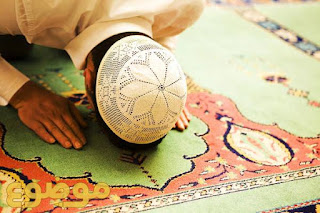
How to Pray Namaz

How to Pray Namaz

With Wuzu, face towards the Qibla and stand so that there is a gap of four fingers between your feet.
Take each hand to each ear and touch the lobes of the ears with the thumbs and leave the rest of the fingers in their normal state, don't join them together or spread them apart.

Face the palms of the hands towards the Qibia and your sight is to look at the sijdah. Then make a firm intention in your heart as to which Namaz you are praying and while saying 'Allah-o-Akbar' lower your hands and join them below the naval. The way to join the hands is to have the palm of the right hand on top of the back of the left hand wrist, keep the middle three fingers straight and circle the left wrist with the thumb and the little finger firmly grasping the hand.

Then pray 'Sana' meaning Subhanakallah Humma Wa Bihamdika Wa Tabarakasmuka Wa Ta'ala Jadduka Wa Laa ila'ha Ghairuk" . Then pray Ta'awwuz meaning "A'oozu Billahi Minas Shaitaanir Rajeem" and then pray Tasmee'a meaning "Bismillah' ir'rahman'ir' Raheem" .

Then pray the whole of the 'Alhamdo' Surat and say 'Aameen' quietly. After this, pray any Surat or three ayats or one ayat which is equivalent to three small ayats.

Then whilst saying Allah-o-Akbar go into the Rukooh. Grasp the knees with the hands and spread your fingers over the knees. Keep your back straight and your head level with your back and make sure that you are not too far up or kneeling to low down and keep your sight on your feet and pray at least three times "Subhana Rabbi'al Azueem' and then pray this whilst standing up 'Sami Allahu Liman Hamidah' and if you are praying Namaz alone then also say 'Allahumma Rabbana Walakal Hamd' and then while saying Allah-o-Akbar go into the Sijdah.

The way to do this is to first put your knees on the ground, then put your hands at the side of the place where your are going to put your head and then place your head by first placing your nose on the ground and then your forehead and then press hard on your nose. Look towards your nose and keep your elbows up so that they don't touch the ground and leave a gap between your armpits and make sure that there is a gap between your thighs and your stomach. Place all your toes so that their tips are pointing towards the Qibla and their bases are flat on the ground. Keep your hands flat and have your fingers pointing towards the Qibla. Then pray at least three times 'Subhana Rabbi al A'ala'.

Then lift your head up while saying Allah-o-Akbar with first lifting your forehead then your nose then your face and then your hands. Keep your right foot upright and lay your left foot flat and sit on it firmly. Place your hands on your knees with the finger tips pointing towards the Qibla and the palm of your hands flat near your knees and the base of the .fingertips laid flat at the end of your kneecaps.

Then whilst saying 'Allah-o-Akbar' go back into the Sijdah and this is done in the same way as the first one. Then stand up by placing your hands on your knees and putting pressure on your knees and legs stand upright, don't put your hands on the ground to assist you to stand up. Now pray only 'Bismillah'ir' Rahmaan'ir' Raheem' and then Alhamdo and another Surat and as before perform Rukooh and Sijdah, and when getting up from the second Sijdah leave your right foot upright and lay your left foot flat and sit upright. And pray •AttahiyyaatuLillahi Was Salawato Wattayyibatu Assalamu Alaika Ayyuhannabi 'o 'Warahmatullahi Wabarka'tuhu Assalamu Alaina Wa'ala'Ibadillahis Sa'liheen, Ash'had'u'un La ilahaillallahu Wa Ash'hadu Anna MuhammadunAbd'uhu Wa Rasooluh', This is known as Tashahhud.

When you are reaching La'ilaha make a circle in your right hand by joining the thumb with the middle finger and curl the small and it's adjacent finger with the middle finger and on the word La lift your index finger but don't move side to side and when you reach 'illallahu' straighten your hand back to normal. Now if you have more than two Ra.kats to pray then stand back up and pray more Rakats, but for a Farz Namaz there is no need to join another Surat after Alhamdo and then continue and when you reach your last Qaidah (sitting position) pray Tashahhud and then pray the DuroodSharif called Durood-e-lbrahim'Allahumma Salleh Ala Sayyidina Muhammadin Wa'ala' Aale Sayyidina Muhammadin Kama Sallaiyta Ala Sayyidina Ibraheema Wa' Ala Aale Sayyidina Ibraheema InnakaHameedum Majeed -Allahumma Baarak Ala Sayyidina Muhammadin Wa' Ala Aale Sayyidina Muhammadin Kama Baarakta Ala Sayyidina Ibraheem Wa' Ala Aale Sayyidina Ibraheema Innaka Hameedum Majeed' After this pray'Allahumag Firii Wali Wale Dayya Wal Ustaad'e Wal Jamee'il Mu'mineena Wal Mu'meenat Wal Muslimeena Wal MuslimatAI'Ahya'eMinhum Wal Amwaat'e Innaka MujeebudDa'waatBirahmatikaYa Ar'hamarr'ahimeen' or pray another Dua-e-Ma'soor or pray 'Allahumma Rabbana Aatina Fid DuniyaHasanatawWafil Akhirati Hasanataw Wa QinaAzaabanNaar' Make sure you pray this by starting it with 'Allahumma' and then turn your head towards your right shoulder and say'Assalamu Alai'kumWarah'matullah' and then turn your head towards your left shoulder and repeat the same words again.

The Namaz has now finished, so raise both your hands and pray any Dua for example'Allahumma Rabbana Aatina Fid Duniya Hasanataw Wafil Akhirati Hasanataw Wa Qina Azaaban Naar' then rub your hands over your face. This is the method for an Imam or a male praying Namaz on their own.

If however, you are a Muqtadee meaning praying in congregation (Jamaat) and behind an Imam then don't perform Qiraayat meaning don't pray 'Alhamdo' or a Surat, whether the Imam is praying loudly or quietly. Qiraayat is not allowed in any Namaz if it is being prayed behind an Imam.

If the Namazee is a female then at the Takbeer-e-Tahrima she should lift her hands only upto her shoulders and then place her left hand on her chest and the right hand on top of it. When performing Rukoo she should only bend a little so that her hands reach her knees and she should not put pressure on her knees and keep her fingers tightly together and not to straighten her back like males.

When performing Sijdah she should crawl up and perform Sijdah so that the arms are joined with the sides, her stomach is joined with her thighs and her thighs are crawled up with her shins and her feet are pointing outwards and are flat. In Qaidah she should have both her feet pointing outwards towards the right and are flat. She should sit on her left buttock and keep her hands in the middle of her thighs.

Monday, August 1, 2011

Ramadan is a time where we must control our desires (nafs) as well as our tongues

Ramadan is a time where we must control our desires (nafs) as well as our tongues


Ramadan is a time where we must control our desires (nafs) as well as our tongues:

Rasulallah (Sallallahu Alaihi Wasallam) said: “Fasting is not (abstaining) from eating and drinking only, but also from vain speech and foul language. If one of you is being cursed or annoyed, he should say: ‘I am fasting, I am fasting.” (Ibn Khuzaimah, Ibn Hibban)

Therefore we must protect our tongue from vain speech and foul language. Protecting the tongue is preventing it from lying, back-biting, slander, tale-carrying, false speech and other things that have been forbidden in the Qur'an & Sunnah.

Those who control their tongues are of the best of Muslims:

The Prophet (Sallallahu Alaihi Wasallam) was asked: “Which Muslim is best?” He responded, “One who the other Muslims are safe from his tongue and his hand.” (Tirmidhi, #2504)

So how can we begin to control our tongues? This can be done by "THINKING BEFORE SAYING ANYTHING". Not just talking without even thinking what we are going to say.

We must think before we speak and before saying anything we should think whether or not what we are going to say is going to please or displease Allah.

If we doubt that what we are about to say may anger or displease Allah then we should refrain from saying it. If we have nothing good to say then surely it is better NOT to say anything at all. Remember we WILL be accountable for everything we said in our lives so we MUST start taking responsiblity for what comes out of our mouths NOW otherwise we will regret it later when it is too late. Therefore we must get into the habit of "thinking before speaking".

REMEMBER: If we do not protect our tongues then our fasts will be in vain:

Rasulallah (Sallallahu Alaihi Wasallam) said: “Allah does not need the fast of one who does not abandon false speech or acting according to his false speech.” (Sahih Bukhari)
Generosity & Charity in Ramadan

Generosity & Charity in Ramadan

Rasulallah (Sallallahu Alaihi Wasallam) became even more generous in Ramadan than he already was.
Ramadan is a time for generosity and giving. It is a time when we think about those who have less than us as well as thank Allah for everything he has given us. Ramadan is an honorable and blessed month, and the rewards for generosity are multiplied in it.

The Prophet (Sallallahu Alaihi Wassallam) said, “The best charity is that given in Ramadan.” (At-Tirmithi).


Prophet (Sallallahu Alaihi Wassallam) said, “He who feeds a fasting person will gain the same reward as he will, without decreasing from the fasting person’s rewards.” (Ahmad).

Therefore we should get into the habit of giving in charity now so by the time Ramadan arrives we would increase in our generosity, giving to those less fortunate than ourselves. We should give whatever we can afford as Allah looks at our intentions.
Roza / Fasting

Roza / Fasting

"O you who believe! Fasting is prescribed for you as it was prescribed for those before you in order that you might learn piety . . . . The month of Ramadan is that wherein was revealed the Qur'an, as a guidance to mankind, and clear proofs of the guidance, and the Criterion. So, whoever among you witnesses the month should fast." [Al-Qur'an 2:183, 185]
"Every deed of the Son of Adam is for himself, except fasting - it is for Me, and I shall reward it." [Muslim, Abu Dawud, Nasa'i, Tirmidhi, Ibn Majah]
"There is not any believer who remains hungry, and abstains from the forbidden things, and does not wrongfully consume the wealth of Muslims, except that Allah will feed him from the fruits of Heaven." [Musnad Abu Hanifah]
"Whoever fasts Ramadan with faith and expectation [of reward], his previous sins are forgiven him." [Bukhari, Muslim, Abu Dawud, Nasa'i]
Rewards of fasting in general
"Fasting is a shield." [Ahmad]
"There is not any servant who fasts a day in the path of Allah, except that Allah will distance him from the Fire by a distance of seventy years." [Bukhari, Muslim]
"Fasting the month of patience and three days of each month remove rancor of the heart." [Ahmad, Bazzar]
Warning against abandoning fasting in Ramadan
"Whoever breaks his fast in Ramadan without a [valid] concession or illness, he cannot repay it, even if he were to fast the rest of his life." [Tirmidhi, Nasa'i, Ibn Majah]
What is Ramadan?

What is Ramadan?

Ramadan is derived from the Arabic root word ramida or ar­ramad denoting intense scorching heat and dryness, especially the ground. From the same root there is ramdaa, sunbaked sand, and the famous proverb: “Kal Mustajeer minar Ramadaa binnar” -to jump out of the frying pan into the fire.

And in a hadith the Messenger of Allah (saas) said:
“The prayer of repenters is due when the young camel can feel the sun's heat early in the morning.” (Muslim)

Thus, the word Ramadan is so called to indicate the heating sensation in the stomach as a result of thirst). Others said it is so called because Ramadan scorches out the sins with good deeds, as the sun burns the ground. Some said it is so called because the hearts and souls are more readily receptive to the admonition and remembrance of Allah during Ramadan, as the sand and stones are receptive to the sun's heat. The framers of this beautiful language may have been inspired by Allah (SWT) in naming this month Ramadan.

Otherwise, the relation between the heat and its properties is miraculously similar to that of Ramadan. While the heat represents the matter that helps shape, form, and mold virtually every matter - from metal and plastics, to plants and living cells -Ramadan undoubtedly helps a serious believer remold, reshape, reform, and renew his physical and spiritual disposition and behavior.

Post your Comments

#Islamic Calendar 2025 Events

Islamic 2025 Event Name English Date Islamic Date
Urs Haji Malang January 2, 2025 - Thursday 10 Jumada al-Akhirah 1446
Urs Haji Ali Baba Mumbai January 4, 2025 - Saturday 12 Jumada al-Akhirah 1446
721st Urs Sharif Of Hazrat Khwaja Syed Nizamuddin Aulia Mehboob-e-Elahi Rahmatullah Alayh January 7, 2025 - Tuesday 15 Jumada al-Akhirah 1446
Urs Khwaja Gharib Nawaz, Ajmer Sharif March 24, 2025 - Monday 22 Sha'ban 1446
Lailat al-Miraj (Shab-e-Meraj) January 27, 2025 - Monday 27 Rajab 1446
Shab-e-Barat February 14, 2025 - Friday 15 Sha'ban 1446
Start of Fasting Month (Ramadan) March 1, 2025 - Saturday 1 Ramadan 1446
Lailat al-Qadr (Shab-e-Qadr) March 27, 2025 - Thursday 27 Ramadan 1446
Jummat-ul-Wida March 28, 2025 - Friday 28 Ramadan 1446
Eid-ul-Fitr March 30, 2025 - Sunday 1 Shawwal 1446
#Hajj June 6, 2025 - Friday 9 Dhul-Hijjah 1446
Eid-ul-Adha (Bakrid) June 7, 2025 - Saturday 10 Dhul-Hijjah 1446
Islamic New Year July 28, 2025 - Monday 1 Muharram 1447
Yaum al-Ashura August 6, 2025 - Wednesday 10 Muharram 1447
Eid Milad-un-Nabi September 26, 2025 - Friday 12 Rabi-al-Awwal 1447