Monday, July 13, 2015
How to perform Eid-ul-Fitr Namaz and Nawafil Namaz (Salat) on day of Eid-ul-Fitr
Steps for Performing Eid-ul-Fitr Namaz
There are six extra Takbeers in Eid Namaz
Three before Qira’at (recitation) and after Takbeer-e-Tahrima in the first Rak’at and
Three after Qira’at in the second Rakat and before the Takbeer for Ruku.
Eid Ul Fitr Namaz ki Niyat (English)
Niyat ki maine 2 rakat namaz Wajib Eid Ul Fitr ki, Zahid 6 Takbiro ke, Muh Kaaba shareef ki taraf, Picha is Imam ke, Allah o Akbar
1) Make intention for Eid-ul-Fitr for two Rakats Wajib as above and then lift your hands up to your ears and say ‘Allahu Akbar’ and then fold them below the navel as normal.
2) Now pray ‘Sana’ and then say Allahu Akbar and lift your hands up to your ears and release them and again lift your hands and say Allahu Akbar and release them again and then lift your hands again and say Allahu Akbar and then fold them.
3) This means fold your hands after the first and fourth Takbeer and in the second and third Takbeers release your hands. The best way to remember is that if the Imam shall recite after the Takbeer then fold your hands and when he shall not recite (after a Takbeer) release your hands and hang them on the side.
4) After folding your hands after the fourth Takbeer the Imam will silently recite ‘A’udhubillah’ and ‘Bismillah’ and then he will pray Surah al-Fatiha (‘Alhamd Sharif’) and a Surat loudly and then go into Ruku and Sijdah and (thus,) complete one Rak’at (unit).
5) Then in the second Rak’at the Imam will first pray the Alhamdu and a Surat then lift your hands to your ears and say Allahu Akbar and release them; and do not fold them and repeat this twice. Therefore a total of three times the Takbeer shall be said. On the fourth time say Allahu Akbar and without lifting your hands go into Ruku.
ईद उल फ़ित्र नमाज़ की नियत और तरीका
नियत की मैंने 2 रकात नमाज़ वाजिब ईद उल फितर की, जाहिद 6 तकबीरो के, मुह काबा शरीफ की तराफ, पिचा इमाम के, अल्लाह ओ अकबर
ईद उल फ़ित्र नमाज़ का तरीका
1) ईद-उल-फितर के लिए ऊपर की तरह दो रकात नमाज़ वजीब का इरादा करें और फिर अपने हाथों को अपने कानों तक उठाएं और 'अल्लाहु अकबर' कहें और फिर उन्हें नाभि के नीचे सामान्य रूप से बांधें।
2) अब 'सना' (सुभानकाल्लाहुम्मा) पड़ें और फिर अल्लाहु अकबर कहें और अपने हाथों को अपने कानों तक उठाएं और उन्हें छोड़ दें और फिर से अपने हाथों को उठाएं और अल्लाहु अकबर कहें और उन्हें फिर से छोड़ दें और फिर अपने हाथों को उठाएं और अल्लाहु अकबर कहें और फिर उन्हें बांधें।
3) इसका मतलब है कि पहली और चौथी तकबीर के बाद अपने हाथ जोड़ लें और दूसरे और तीसरे तकबीर में हाथ छोड़ दें। याद रखने का सबसे अच्छा तरीका यह है कि अगर तकबीर के बाद इमाम पढ़े तो अपने हाथ जोड़ लें और जब वह (तकबीर के बाद) न पढ़े तो अपने हाथों को छोड़ दें और उन्हें किनारे पर लटका दें।
4) चौथे तकबीर के बाद हाथ जोड़कर इमाम चुपचाप 'औदुबिल्लाह' और 'बिस्मिल्लाह' पढ़ेंगे और फिर सूरह अल-फातिहा ('अल्हमद शरीफ') और एक सूरत को जोर से पढ़ेंगे और फिर रुकू और सिजदा में जाएंगे। और (इस प्रकार,) एक रकअत (इकाई) को पूरा करें।
5) फिर दूसरी रकअत में इमाम पहले अल्हम्दु और सूरत की नमाज़ अदा करेंगे फिर अपने हाथों को अपने कानों तक उठाएँगे और अल्लाहु अकबर कहेंगे और उन्हें छोड़ देंगे; और उन्हें फोल्ड न करें और इसे दो बार दोहराएं। इसलिए कुल तीन बार तकबीर कहा जाएगा। चौथी बार अल्लाहु अकबर बोलो और बिना हाथ उठाए रुकू में जाओ।
नमाज़ के बाद क़ुत्बा होगा फिर दुआ और सलाम होग। दुआ की गुज़ारिश
Nawafil Namaz (Salat and Dua) in on day of Eid-ul-Fitr Namaz
8 Rakats (4 Salams)
On the first day of Shawwal (Day of Eid) after Zuhr Namaz in Afternoon Pray 8 Rakats with 4 salam. In Each Rakat, Read Sureh Fatiha once and Sureh Iqla 25 times.
After Salam Read Subhan Allah 70 Times, Astagfirullah 70 times and below Darood sharif 70 times
Allahumma salli-ala muhammadin nabiyil ummiyi wa-ala alaihi wa ashabihi wa barik wa sallam
Rewards: Allah will grants 70 wishes in this world and 70 wishes on the judgement day and the doors of Rehmat will be opened for him. Insha Allah
Remember in your Dua
Eid Namaz for Women
It is not permissible for females to perform the Eidain prayers, as there shall be mixing between the men and the women in the Eidgah (place where the Eid prayer is performed). This is why it is not permissible for females to go to the Masajid to perform salaah with congregation; whether they go in day or at night; whether for Jum’ah or for Eidain; whether they are old or young. [This has been stated in Tanwir al-Absar and al-Durr al-Mukhtar Page 114]
Yes, however, before Zawal women can perform the 2 or 4 rak’ats Chasht (Salatud Duha) prayer at home, after the Eidain prayer has finished. [Bahar-e-Shari’at – Vol. 1, Chapter 4, Page 94]
3. If only the women have their own congregation for salaah, then this is also not permissible, as the congregation held by women between themselves (to perform salaah) is not allowed, in fact it is strictly disliked (Makruh-e-Tehrimi). [This has been stated in Fatawa-e-’Alamgiri Vol. 1 Page 80, also in al-Durr al-Mukhtar Page 77]
4. Even if women pray the Eidain prayer on their own, then this is also not permissible as it is a condition to establish the Eidain prayer that it is performed with a congregation. Yes! Women should pray the nafl (supererogatory) salaah on that day; at home, on their own. Insha’Allah they shall receive the blessings and rewards of that day.
SUREHS TO BE READ IN NAMAZ
SANA
SubhanakALLAHumma Wa Bi’hamdika Wa Tabaara Kasmukaa, Wa Ta’ala Jaddukaa Wa La Ilaaha Ghairuk
SURAH AL-FATIHA
Alhamdul lil-lahi rab-bil 'alameen
Ar rahma nir-raheem
Maliki yawmid-deen
Iyyaka na'budu wa iyyaka nasta'een
Ihdinas siratal mustaqeem
Siratal Lazeena an'amta 'alayhim
Ghai-ril maghdubi 'alayhim
Walad dal-leen. Ameen.
SURAH AL-IKHLAS
Qul huwal lahu ahad.
Allah hus-Samad.
Lam yalid walam yulad.
Walam yakul-lahu Kufuwan ahad.
SUREH QADR
Innaa Anzalnaahu Fee Lailatil Qadr
Wa Maa Adraaka Ma Lailatul Qadr
Lailatul Qadri Khairum Min Alfee Shahr
Tanaz Zalul Malaa-ikatu War Roohu Feeha Bi Izni-rab Bihim Min Kulli Amr
Salaamun Hiya Hattaa Mat La'il Fajr
SUREH NASR
Iza Jaa-a Nas Rullahi Walfath
Wa Ra-aitan Naasa Yadkhuloona Fee Deenil Laahi Afwajah
Fa Sab Bih Bihamdi Rabbika Was Taghfir, Innahu Kaana Tawwaaba
AYTAL KURSI
Allahu laaa ilaaha illaa huwal haiyul qai-yoom; laa taakhuzuhoo sinatunw wa laa nawm; lahoo maa fissamaawaati wa maa fil ard; man zallazee yashfa'u indahooo illaa be iznih; ya'lamu maa baina aideehim wa maa khalfahum; wa laa yuheetoona beshai 'immin 'ilmihee illa be maa shaaaa; wasi'a kursiyyuhus samaa waati wal arda wa la ya'ooduho hifzuhumaa; wa huwal aliyyul 'azeem
ATTAHIYAT
AttahiyyaatuLillahi Was Salawatu Wattayyibatu
Assalamu Alaika Ayyuhannabi 'yu 'Warahmatullahi Wabarka'tuhu
Assalamu Alaina Wa'ala'Ibadillahis Saa'liheen
Ash'had'u'un La ilahaillallahu
Wa Ash'hadu Anna MuhammadunAbd'uhu Wa Rasooluhu
DAROOD-E-IBRAHIM
Allahumma Salleh Ala Sayyidina Muhammadin Wa'ala' Aale Sayyidina Muhammadin Kama Sallaiyta Ala Sayyidina Ibraheema Wa' Ala Aale Sayyidina Ibraheema InnakaHameedum Majeed -Allahumma Baarak Ala Sayyidina Muhammadin Wa' Ala Aale Sayyidina Muhammadin Kama Baarakta Ala Sayyidina Ibraheem Wa' Ala Aale Sayyidina Ibraheema Innaka Hameedum Majeed
Then Read the below Dua
Allahumag Firii Wali Wale Dayya Wal Ustaad'e Wal Jamee'il Mu'mineena Wal Mu'meenat Wal Muslimeena Wal MuslimatAI'Ahya'eMinhum Wal Amwaat'e Innaka MujeebudDa'waatBirahmatikaYa Ar'hamarr'ahimeen'
or pray another Dua-e-Ma'soor or pray
'Allahumma Rabbana Aatina Fid DuniyaHasanatawWafil Akhirati Hasanataw Wa QinaAzaabanNaar'
DUA QUNOOT (READ IN 3RD RAKAT OF WITR IN ISHA)
Allah humma inna nast'eenuka wa nastaghfiruka
wa nu'minu bika wa natawak-kalu 'alayka wa nuthne 'alayk-al khayr.
Wa nashkuruka wa laaa nakfuruka wa nakhla'u wa natruku man-y yafjuruka.
Allah humma iyyaka na'budu wa laka nusal-lee
wa nasjudu wa ilayka nas'a wa nahfidu wa narju rahmataka
wa nakhsha 'azabaka inna 'azabaka bil kuf-fari mulhiq.
A FEW MASA’IL REGARDING EID SALAAH (EID NAMAZ FAQS)
1. If the Imam forgets to recite the extra Takbirs in the first rak’ah and if he remembers after reciting surah Al-Fatihah, he should recite the extra Takbir and repeat surah Al-Fatihah.
2. If a person joins the Eid salaah after the Imam has completed the extra Takbirs then he should recite the Takbir of Tahrimah and immediately, the additional Takbirs, dropping the hands between the first two additional Takbirs and clasping them after the third, making sure that the hands are raised to the ears on each Takbir.
3. Since the condition of Eid salaah is the formation of a jama’ah, a person who missed Eid salaah is unable to perform the salaah on his own. There is no Qadha for Eid salaah.
4. A person who joins the Eid salaah after the Imam has already recited the Eid Takbir should recite the Takbir immediately upon entering the salaah. However, if he enters the salaah when the Imam is about to go into Ruku and he (the late-comer) fears that he will not be able to join the Imam in the Ruku if he stands and recites the Takbir, then he should instead recite the Takbir in the Ruku, and forgo the tasbih of the Ruku but, while reciting the Takbir in Ruku the hands should not be raised as is done when reciting the Takbir when in Qiyam (the standing posture of salaah). If the Imam emerges from the Ruku and the latecomer has not yet completed the recitation of his Takbir which he had missed then he should leave off the balance of the Takbir and join the Imam. In this case the balance of the Takbir which he could not complete are waived.
5. If someone missed a Rak’ah of the Eid Salaah, he should fulfil it as follows: After the Imam completes the salaah, he (the one who missed the Rak’ah) should rise and perform one Raka’h on his own, reciting Qira’ah (Surah Al-Fatiha plus a Surah) first, followed by the Takbirs. The rest of the Rak’ah is then completed as usual.
Alhamdul lil-lahi rab-bil 'alameen
Ar rahma nir-raheem
Maliki yawmid-deen
Iyyaka na'budu wa iyyaka nasta'een
Ihdinas siratal mustaqeem
Siratal Lazeena an'amta 'alayhim
Ghai-ril maghdubi 'alayhim
Walad dal-leen. Ameen.
SURAH AL-IKHLAS
Qul huwal lahu ahad.
Allah hus-Samad.
Lam yalid walam yulad.
Walam yakul-lahu Kufuwan ahad.
SUREH QADR
Innaa Anzalnaahu Fee Lailatil Qadr
Wa Maa Adraaka Ma Lailatul Qadr
Lailatul Qadri Khairum Min Alfee Shahr
Tanaz Zalul Malaa-ikatu War Roohu Feeha Bi Izni-rab Bihim Min Kulli Amr
Salaamun Hiya Hattaa Mat La'il Fajr
SUREH NASR
Iza Jaa-a Nas Rullahi Walfath
Wa Ra-aitan Naasa Yadkhuloona Fee Deenil Laahi Afwajah
Fa Sab Bih Bihamdi Rabbika Was Taghfir, Innahu Kaana Tawwaaba
AYTAL KURSI
Allahu laaa ilaaha illaa huwal haiyul qai-yoom; laa taakhuzuhoo sinatunw wa laa nawm; lahoo maa fissamaawaati wa maa fil ard; man zallazee yashfa'u indahooo illaa be iznih; ya'lamu maa baina aideehim wa maa khalfahum; wa laa yuheetoona beshai 'immin 'ilmihee illa be maa shaaaa; wasi'a kursiyyuhus samaa waati wal arda wa la ya'ooduho hifzuhumaa; wa huwal aliyyul 'azeem
اللَّهُ لاَ إِلَهَ إِلاَّ هُوَ الْحَيُّ الْقَيُّومُ لاَ تَأْخُذُهُ سِنَةٌ وَلاَ نَوْمٌ لَهُ مَا فِي السَّمَاوَاتِ وَمَا فِي الأَرْضِ مَنْ ذَا الَّذِي يَشْفَعُ عِنْدَهُ إِلاَّ بِإِذْنِهِ يَعْلَمُ مَا بَيْنَ أَيْدِيهِمْ وَمَا خَلْفَهُمْ وَلاَ يُحِيطُونَ بِشَيْءٍ مِنْ عِلْمِهِ إِلاَّ بِمَا شَاءَ وَسِعَ كُرْسِيُّهُ السَّمَاو ;َاتِ وَالأَرْضَ وَلاَ يَئُودُهُ حِفْظُهُمَا وَهُوَ الْعَلِيُّ الْعَظِيمُ
ATTAHIYAT
AttahiyyaatuLillahi Was Salawatu Wattayyibatu
Assalamu Alaika Ayyuhannabi 'yu 'Warahmatullahi Wabarka'tuhu
Assalamu Alaina Wa'ala'Ibadillahis Saa'liheen
Ash'had'u'un La ilahaillallahu
Wa Ash'hadu Anna MuhammadunAbd'uhu Wa Rasooluhu
DAROOD-E-IBRAHIM
Allahumma Salleh Ala Sayyidina Muhammadin Wa'ala' Aale Sayyidina Muhammadin Kama Sallaiyta Ala Sayyidina Ibraheema Wa' Ala Aale Sayyidina Ibraheema InnakaHameedum Majeed -Allahumma Baarak Ala Sayyidina Muhammadin Wa' Ala Aale Sayyidina Muhammadin Kama Baarakta Ala Sayyidina Ibraheem Wa' Ala Aale Sayyidina Ibraheema Innaka Hameedum Majeed
Then Read the below Dua
Allahumag Firii Wali Wale Dayya Wal Ustaad'e Wal Jamee'il Mu'mineena Wal Mu'meenat Wal Muslimeena Wal MuslimatAI'Ahya'eMinhum Wal Amwaat'e Innaka MujeebudDa'waatBirahmatikaYa Ar'hamarr'ahimeen'
or pray another Dua-e-Ma'soor or pray
'Allahumma Rabbana Aatina Fid DuniyaHasanatawWafil Akhirati Hasanataw Wa QinaAzaabanNaar'
DUA QUNOOT (READ IN 3RD RAKAT OF WITR IN ISHA)
Allah humma inna nast'eenuka wa nastaghfiruka
wa nu'minu bika wa natawak-kalu 'alayka wa nuthne 'alayk-al khayr.
Wa nashkuruka wa laaa nakfuruka wa nakhla'u wa natruku man-y yafjuruka.
Allah humma iyyaka na'budu wa laka nusal-lee
wa nasjudu wa ilayka nas'a wa nahfidu wa narju rahmataka
wa nakhsha 'azabaka inna 'azabaka bil kuf-fari mulhiq.
A FEW MASA’IL REGARDING EID SALAAH (EID NAMAZ FAQS)
1. If the Imam forgets to recite the extra Takbirs in the first rak’ah and if he remembers after reciting surah Al-Fatihah, he should recite the extra Takbir and repeat surah Al-Fatihah.
2. If a person joins the Eid salaah after the Imam has completed the extra Takbirs then he should recite the Takbir of Tahrimah and immediately, the additional Takbirs, dropping the hands between the first two additional Takbirs and clasping them after the third, making sure that the hands are raised to the ears on each Takbir.
3. Since the condition of Eid salaah is the formation of a jama’ah, a person who missed Eid salaah is unable to perform the salaah on his own. There is no Qadha for Eid salaah.
4. A person who joins the Eid salaah after the Imam has already recited the Eid Takbir should recite the Takbir immediately upon entering the salaah. However, if he enters the salaah when the Imam is about to go into Ruku and he (the late-comer) fears that he will not be able to join the Imam in the Ruku if he stands and recites the Takbir, then he should instead recite the Takbir in the Ruku, and forgo the tasbih of the Ruku but, while reciting the Takbir in Ruku the hands should not be raised as is done when reciting the Takbir when in Qiyam (the standing posture of salaah). If the Imam emerges from the Ruku and the latecomer has not yet completed the recitation of his Takbir which he had missed then he should leave off the balance of the Takbir and join the Imam. In this case the balance of the Takbir which he could not complete are waived.
5. If someone missed a Rak’ah of the Eid Salaah, he should fulfil it as follows: After the Imam completes the salaah, he (the one who missed the Rak’ah) should rise and perform one Raka’h on his own, reciting Qira’ah (Surah Al-Fatiha plus a Surah) first, followed by the Takbirs. The rest of the Rak’ah is then completed as usual.
REMEMBER TO PAY YOUR FITRAH
Allah's Name (we) begin with, The Compassionate Most Merciful
As Salaatu Was Salaamu Alaika Ya Rasool'Allah
صلٰى الله عليه و سلم
REMEMBER TO PAY YOUR FITRAH
Abu Dawud, Ibn Majah and Haakim have reported from Ibn Ab’bas radi Allahu anhu that Rasoolullah Sall Allahu alaihi wa Sallam stipulated the Zakaat-ul-Fitr, (i.e. Fitrah) so that the fasts may be purified from shameless and vulgar words and so that the needy (Miskeen) may be fed.
Dailmi, Khateeb and Ibn Asaakir report from Anas radi Allahu anhu that Rasoolullah Sall Allahu alaihi wa Sallam said, ‘the fasts of a servant remains suspended between the skies and the earth, until he does not discharge the Sadaqa e Fitr.’
Law: For Sadaqa e Fitr to become Waajib, fasting is not conditional. If one did not fast due to some valid reason, or due to travelling, or due to an illness, or old-age or (Allah Forbid) if he left out the fast without a valid reason, then in all the said cases, the Sadaqa e Fitr is still Waajib. [Raddul Muhtar]
Law: If a person paid the Fitrah of his wife and his Baaligh children without their permission, it will be counted as being discharged, on condition that the children are from his Ay’yal. In other words, the provisions etc. of those children are his responsibility. Otherwise, it will not be regarded as discharged if he does so, on behalf of his children without their permission. If the wife paid the Fitrah of her husband without his authority, it will not be discharged. [Alamgiri vol.1 pg.193, Raddul Muhtar vol.2 pg.102/103 etc]
MASLAK E AALA HAZRAT
ZINDA BAAD!
Sag e Mufti e Azam
Muhammad Afthab Cassim Qaadiri Razvi Noori
Imam Mustafa Raza Research Centre, Durban, South Africa
As Salaatu Was Salaamu Alaika Ya Rasool'Allah
صلٰى الله عليه و سلم
REMEMBER TO PAY YOUR FITRAH
Abu Dawud, Ibn Majah and Haakim have reported from Ibn Ab’bas radi Allahu anhu that Rasoolullah Sall Allahu alaihi wa Sallam stipulated the Zakaat-ul-Fitr, (i.e. Fitrah) so that the fasts may be purified from shameless and vulgar words and so that the needy (Miskeen) may be fed.
Dailmi, Khateeb and Ibn Asaakir report from Anas radi Allahu anhu that Rasoolullah Sall Allahu alaihi wa Sallam said, ‘the fasts of a servant remains suspended between the skies and the earth, until he does not discharge the Sadaqa e Fitr.’
Law: For Sadaqa e Fitr to become Waajib, fasting is not conditional. If one did not fast due to some valid reason, or due to travelling, or due to an illness, or old-age or (Allah Forbid) if he left out the fast without a valid reason, then in all the said cases, the Sadaqa e Fitr is still Waajib. [Raddul Muhtar]
Law: If a person paid the Fitrah of his wife and his Baaligh children without their permission, it will be counted as being discharged, on condition that the children are from his Ay’yal. In other words, the provisions etc. of those children are his responsibility. Otherwise, it will not be regarded as discharged if he does so, on behalf of his children without their permission. If the wife paid the Fitrah of her husband without his authority, it will not be discharged. [Alamgiri vol.1 pg.193, Raddul Muhtar vol.2 pg.102/103 etc]
MASLAK E AALA HAZRAT
ZINDA BAAD!
Sag e Mufti e Azam
Muhammad Afthab Cassim Qaadiri Razvi Noori
Imam Mustafa Raza Research Centre, Durban, South Africa
Sunday, July 12, 2015
Namaz (Salat and Dua) and Fasting in Shawwal Month
Fasting the Six Days of Shawwal
Fasting six days of Shawwal from second day of Shawwal month has lots of Blessings and immense reward. These six days fastings are Sunnah, not wajib.
The person who fasts these six days will rewarded with the rewards of fastings for 1000 fast. Fire will be haram for this person and his ammal (judgement day report) will be filled with immense rewards.
Its not compulsory that a person has to keep the six fasts continuously. He can keep it as per his convenience but it must be done in the same month of Shawwal.
Namaz (Salat and Dua) in Shawwal Month
1) 4 Rakats (2 Salams)
In the first night (After Isha Namaz) of Shawwal month, Pray 4 Rakats with 2 Salams.
In every Rakat, read Sureh Fatiha once and Sureh Iqlas 21 times.
Rewards: Allah will open doors of Janah (Heaven)for this person and close the doors of Jahanam (Hell)
2) 4 Rakats (2 Salams)
In the first night (After Isha Namaz) of Shawwal month, Pray 4 Rakats with 2 Salams.
In every Rakat, read Sureh Fatiha once and Sureh Iqlas, Sureh Falaq and Sureh Naas 3 times.
After Salam Read 3rd Third Kalma (Tamjeed) 70 times given below and repent for his sins in dua
Subhanallahi Wal Hamdulillahi Wa Laa ilaha illal Laho Wallahooakbar. Wala Haola Wala Quwwata illa billahil AliYil Azeem.
Rewards: Allah will forgive his sins and his repentance will be accepted. Insha Allah
3) 8 Rakats (4 Salams) | Namaz on Eid Ul Fitr
On the first day of Shawwal (Day of Eid) after Zuhr Namaz in Afternoon Pray 8 Rakats with 4 salam. In Each Rakat, Read Sureh Fatiha once and Sureh Iqla 25 times.
After Salam Read Subhan Allah 70 Times, Astagfirullah 70 times and below Darood sharif 70 times
Allahumma salli-ala muhammadin nabiyil ummiyi wa-ala alaihi wa ashabihi wa barik wa sallam
Rewards: Allah will grants 70 wishes in this world and 70 wishes on the judgement day and the doors of Rehmat will be opened for him. Insha Allah
Hadiths on Shawwal Fasting (Roza)
1) Sayyiduna Ayyub (Allah be pleased with him) relates that the Messenger of Allah (blessings and peace be upon him, his family, and companions) said,
“Whoever fasts Ramadan and follows it with six days from Shawwal it is as if they fasted the entire year.” [Muslim, Abu Dawud, Tirmidhi, and Ibn Majah; Ahmad transmitted it from Jabir, Muntaqa]
2) Sayyiduna Thawban (Allah be pleased with him) relates that the Messenger of Allah (blessings and peace be upon him, his family, and companions) said,
“Whoever fasts Ramadan, and then six days after Eid, it is an entire year. Whoever does a good deed shall have ten times its reward.” [Ibn Majah, Muntaqa]
Nafil Namaz in Hindi (Shawwal Namaz Hindi Mein)
Fasting six days of Shawwal from second day of Shawwal month has lots of Blessings and immense reward. These six days fastings are Sunnah, not wajib.
The person who fasts these six days will rewarded with the rewards of fastings for 1000 fast. Fire will be haram for this person and his ammal (judgement day report) will be filled with immense rewards.
Its not compulsory that a person has to keep the six fasts continuously. He can keep it as per his convenience but it must be done in the same month of Shawwal.
Namaz (Salat and Dua) in Shawwal Month
1) 4 Rakats (2 Salams)
In the first night (After Isha Namaz) of Shawwal month, Pray 4 Rakats with 2 Salams.
In every Rakat, read Sureh Fatiha once and Sureh Iqlas 21 times.
Rewards: Allah will open doors of Janah (Heaven)for this person and close the doors of Jahanam (Hell)
2) 4 Rakats (2 Salams)
In the first night (After Isha Namaz) of Shawwal month, Pray 4 Rakats with 2 Salams.
In every Rakat, read Sureh Fatiha once and Sureh Iqlas, Sureh Falaq and Sureh Naas 3 times.
After Salam Read 3rd Third Kalma (Tamjeed) 70 times given below and repent for his sins in dua
Subhanallahi Wal Hamdulillahi Wa Laa ilaha illal Laho Wallahooakbar. Wala Haola Wala Quwwata illa billahil AliYil Azeem.
Rewards: Allah will forgive his sins and his repentance will be accepted. Insha Allah
3) 8 Rakats (4 Salams) | Namaz on Eid Ul Fitr
On the first day of Shawwal (Day of Eid) after Zuhr Namaz in Afternoon Pray 8 Rakats with 4 salam. In Each Rakat, Read Sureh Fatiha once and Sureh Iqla 25 times.
After Salam Read Subhan Allah 70 Times, Astagfirullah 70 times and below Darood sharif 70 times
Allahumma salli-ala muhammadin nabiyil ummiyi wa-ala alaihi wa ashabihi wa barik wa sallam
Rewards: Allah will grants 70 wishes in this world and 70 wishes on the judgement day and the doors of Rehmat will be opened for him. Insha Allah
Hadiths on Shawwal Fasting (Roza)
1) Sayyiduna Ayyub (Allah be pleased with him) relates that the Messenger of Allah (blessings and peace be upon him, his family, and companions) said,
“Whoever fasts Ramadan and follows it with six days from Shawwal it is as if they fasted the entire year.” [Muslim, Abu Dawud, Tirmidhi, and Ibn Majah; Ahmad transmitted it from Jabir, Muntaqa]
2) Sayyiduna Thawban (Allah be pleased with him) relates that the Messenger of Allah (blessings and peace be upon him, his family, and companions) said,
“Whoever fasts Ramadan, and then six days after Eid, it is an entire year. Whoever does a good deed shall have ten times its reward.” [Ibn Majah, Muntaqa]
Nafil Namaz in Hindi (Shawwal Namaz Hindi Mein)
![]() |
| shawwal namaz in hindi |
Wednesday, July 8, 2015
The Meanings of the Salat (Prayer) with English Translation
| Arabic Transliteration | English Translation |
|---|---|
| "Subhana Kal-lah hum-ma wabi hamdika wata-bara kasmuka wata'ala jad-duka wala ilaha ghyruka.” |
"Glory be to you oh Allah, and Praise. Blessed be Your name and exalted be Your majesty. There is no god but You" |
| “A'udhu bil-lahi minash Shayta-nir-rajeem” | "I seek Allah's shelter from Satan, the condemned" |
| "Bismillah hir-Rahman nir-Raheem” | "In the Name of Allah, the Gracious, the Merciful." |
| "Alhamdul lil-lahi rab-bil 'alameen Ar rahma nir-raheem Maliki yawmid-deen Iyyaka na'budu wa iyyaka nasta'een Ihdinas siratal mustaqeem Siratal Ladheena an'amta 'alayhim Ghai-ril maghdubi 'alayhim Walad dal-leen. (Ameen)" |
"Praise be to Allah, the Sustainer of the Worlds; Most Gracious, Most Merciful; Master of the Day of Judgment. Only you do we worship, and only your help we seek Show us the straight way The way of those whom you bestowed your Grace, Those whose (portion) is not wrath And who go not astray." |
| "Sub-hana Rabbi-al 'azeem" | “Glorified is my Lord, the Almighty” |
| "Sami 'allah hu liman hamida. | "Allah listens to him who praises Him" |
| "Rab-bana lakal hamd" | "Our Lord, praise be for you only” |
| "Allah u Akbar" | "Allah is the greatest" |
| “Sub-hana Rabbi yal a'la” | “Glory to Allah, the Exalted" |
| "At-tahiy-yatu lil-lahi was sala-watu wat-tay yibatu. As-salamu 'alayka ay-yuhan-nabiy-yu wa rahma tullahi wa bara-katuhu As-salamu 'alayna wa'ala 'ibadil-la his-sali-heen” |
"All our salutations are for Allah, and prayers, and good deeds. Peace, mercy and blessing of Allah be on you, O Prophet. May peace be upon us and on the devout slaves of Allah.” |
| “Ash hadu al-la ilaha il-lal lahu wa ash hadu an-na Muhammadan 'ab-duhu wa rasuluh.” |
“I testify that there is no god but Allah and I testify that Muhammad is His slave and messenger". |
| "Allah humma sal-li 'ala Muhammadin wa 'ala ali Muhammadin, Kama sal-layta 'ala Ibraheema Wa'ala ahli Ibraheema innaka Hameedum Majeed Allah humma barik 'ala Muhammadin wa 'ala ali Muhammadin, Kama barakta 'ala Ibraheema Wa 'ala ahli Ibraheema innaka Hameedum Majeed.” |
"Oh Allah send your Mercy on Muhammad and his posterity as you sent Your mercy on Abraham and his posterity. You are the Most Praised, The Most Glorious. Oh Allah, send your Blessings on Muhammad and his posterity as you have blessed Abraham and his posterity. You are the Most praised, The Most Glorious". |
| “Rubbana ‘atayna fi dunya hasanatuh, wa fil akheratay hasanatuh, wa qina a'zaban nar.” |
Our Lord, grant us the good of this world and of the Hereafter and save us from the torture of the Fire |
| "As-salamu 'alaykum wa rah-matul lah". | "Peace and mercy of Allah be on you". |
Prophet ( Peace be upon him) loved the short but comprehensive, meaningful supplications
Aishah (R) says that the Prophet ( Peace be upon him) loved the short but comprehensive, meaningful supplications more than others. Following are some of these supplications, which are a must for every believer.
اللهم آتنا في الدنيا حسنه وفي
الاخرة حسنه وقنا عذاب النار
'Allahumma Rabbana Atina fid-dunya hasanatan wafil- Akhirati hasanatan waqina athaban nar.' (O Allah, our Lord, give us all the good of this world, and the good of the life hereafter, and save us from the punishment of the hell-fire.) (Muslim) |
*****
اللهم اعيني على ذكرك وشكرك وحسن
عبادتك
'Alahumma a'innee ala thikrika wa shukrika wa hus nee ibadatika.' (O Allah, assist me in remembering You and being grateful to You and performing Your worship in an excellent manner.) (Muslim) |
*****
اللهم اني ظلمت نفسي ظلما كثيرا
ولا يغفر الذنوب الا انت فاغفرلي مغفرة من عندك, وارحمني انك انت الغفور الرحيم
'Alla-humma innee thalamtu nafsee thulman kathee-ra wala yaghfiru thunouba ila anta, faghfirlee maghfiratan min 'indika, warr hamnee innaka antal Ghafoor-ur Raheem.' (O Allah! I have wronged myself very much, and none can forgive sins, except You only. Grant me forgiveness, and have mercy upon me; indeed You are the Most Forgiving, Ever Merciful.)" (Bukhari & Muslim) |
*****
اللهم اصلح لي ديني الذي هو عصمة
امري, واصلح لي دنياي التي فيها معاشي, واصلح لي اخرتي التي
فيها معادي, واجعل الحياة زيادة لي في كل خير, واجعل الموت راحة لي من كل شر
'Allahumma ashlehlee deeni al lathee huwa 'ismato amree wa asleh lee dunya ya allati feeha ma'ashi wa asleh lee aakhiratee allati feeha ma'adi waj al hayata zeeya-datal-li fee kullee khairan Waj-al mawta ra hatan lee min kullee sharree.'
(O Allah! Correct for me my faith, which is the guard of my affairs, make better my world where I have my livelihood, set right my hereafter where I have to return ultimately, make my life long, in every type of virtue, and make my death a comfort against all evils.) (Muslim)
Importance and Merits of Jumma Prayer (Friday prayers)
Jumma day is a Blessed Day, a day on which Hazrath Adam alayhis 'salam was born and so the Blessed day is know as Eid-ul-Momineen.
Allah Subhanahu wa Ta'ala honoured Islam there with and gave glory to the Muslims. Allah Subhanahu wa Ta'ala says: when there is azan for the prayer on the Jumma day, run towards rememberence of ME and give up buy and sale. The Most Honourable Prophet Salla Allahu ta'ala 'alayhi wa Sallam said: Allah Subhanahu wa Ta'ala has made compulsory on you on this day of mine and in this place of mine. The Most Honourable Prophet Salla Allahu ta'ala 'alayhi wa Sallam said: if a man loses three Jumas without any excuse, Allah Subhanahu wa Ta'ala puts a seal in his mind. In another narration : He throws Islam on his back.
There are seven conditions for a salaat to be corrected.
1-Niyyat (intention)
2-Tahrima (To say Allah Akbar)
3-Qiyam (Standing)
4-Qiraat (Recitation of Quran by mouth gently)
5-Ruku (To bow)
6-Sajda (Prostration)
7-Qai'da-e- Akhira (Last sitting)
NIYYAT (intention) is made while saying the takbir at the beggining. It is permissible to make niyyat before that, too.
(I) To make niyyat for salaat means to intend in the heart to perform a particular Salaat - Its name, time, qibla, to wish to follow the imam (when performing salaat in jama'at) etc. Such as saying, "I pray two rakat (or as many required for that time) Fard (if its Fard or say Sunnat if its Sunnat or say Wajib if its Wajib or Say Nafil if its Nafil) of Fajr (or whichever Salaat it is) for Allah Ta'ala and facing towards the Ka'aba."
(ii) Knowledge only, that is, knowing what is to be done will not be niyyat.
(iii) The niyyat made after the takbir of beginning is not correct and that salaat is not acceptable.
(iv) When making niyyat for prayers that are fard or wajib, it is necessary to know which fard or wajib they are. For example, it is necessary to know the name of the fard and to say for instance, "To perform today's early afternoon prayer (Zuhr)," or, the time's fard." When performing the salaat of Eid or witr, it is necessary to think of its being wajib and its name.
(v) It is good (mustahab) but not necessary to make niyyat for the number of rak'ats (cycles).
(vi) When performing a sunnat the niyyat "To perform salaat will suffice."
(vii) When beginning to worship, saying orally only is not called niyyat. Worships done without niyyat are not acceptable in all four Madhhabs (Hanfi, Shaafi, Maliki and Hambali). Thus niyyat is done from the heart.
TAHRIMA
means to say "Allahu Akbar"
When beginning salaat it is Fard to say Tahrima. No other word to replace it is acceptable. If the takbir is said too long, like AAllah (with AA instead of one A) in the beginning or Akbaar (with aa instead of one a) at the end, salaat will not be accepted. If 'Takbir' is said before the Imam, salaat will not have started.
QIYAM means to stand.
(I) When standing, the two feet must be four finger's width apart from each other.
(ii) In Fards,Wajibs and in the sunnat of Fajr salaat Qiyam is Fard. It means a person who is healthy but performs the above mentioned salaat while sitting, is not acceptable, He must perform all of the mentioned Salaats with qiyam for his salaat to be accepted.
(iii) He who is too ill to stand should perform salaat sitting, and if too ill to sit he should lie down on his back and performs it with his head (by moving,nodding his head,etc,). A pillow must be put under his head so that his face will be towards the qibla instead of towards the sky. He bends his knees, so that he will not stretch his legs towards the qibla.
(iii) As qirat is wajib to recite Surah
Fatiha and to also recite a sura or three ayats in every rak'at of
sunnats and of witr prayer and in the first two rak'ats of the fard.
(iv) In the fard (prayers of salaat that are obligatory), it is wajib to say the Fatiha and the other sura at the two first rak'ats. Additionally, it is wajib to say Surah Fatiha before the sura. Furthermore, it is wajib to say the fatiha once in every rak'at. If one of these five wajibs is forgotten, it is necessary to make sajda-e-sahw.
(v) In the third and the fourth rak'ats of the fard, it is sunnat for the Imam as well as for a person who performs salaat individually to say the Fatiha. [Ibni Abidin shami, p 343].
(vi) A settled (resident) person who follows a traveling one stands up when the imam makes the salam after the second rak'at,and performs two more rak'ats,but he does not make the qirat. That is, he does not say the Fatiha or the other sura. He does not say any prayer as if he were praying salaat behind the imam.
(vii) In every prayer of salaat except Friday prayer and Eid prayer, it is sunnat for the imam that the sura he says in the first rak'at (after the Fatiha) be twice as long as the one he says in the second rak'at.
(viii) It is makruh to say a sura in the second rak'at three ayats longer than the sura said in the first rak'at.It is always wajib to read the suras or ayats from the Qur'an.
(xi) A person who is too ill to stand, or feels dizzy or has a headache or toothache or pain in some other part of his body or can not control wind or bleeding when he stands should perform salaat sitting.
QIRAT: Means to read (recite) by mouth gently. Reading gently means to read only as loud as can hear yourself. (I) The recitation is called Jahri, that is, loud if its heard by people who stand on each side of the recitor. (ii) It is fard to say an ayat (verse) of the Quran while in Qiyam (standing) in every Rakat and it must be in the order as they are written in the Quran. For example one cannot recite Surah Naas in first rakaat and Surah Ikhlas in second.
RUKU: After the sura you bend for Ruku whilst saying takbir. (I) In ruku men open their fingers and put them on their knees. They keep their back and head leveled in ruku. Also the arms and legs must be straight and then you say, "Subhana Rabbiyel Azeem" at least thrice. (ii) If the imam raises his head before you have said it three times you must raise your head too. You must not wait to complete the recitation thrice. In Ruku women do not open their fingers, they do not keep their head and back level, nor their arms and legs straight.
It is sunnat, for the imam as well as a person who is performing salaat alone, to say 'Sami Allahu liman hamidah' while straightening up from Ruku. The Jama'at does not say it. Right after saying it (if praying alone) or upon hearing the imam recite it (if with jama'at), you must say 'Rab'bana lakal hamd', and stand upright. Then, saying takbir (Allahu Akbar) start to kneel down for the Sajdah. First place the right knee and then the left knee, followed by the right and then left hand on the floor. Finally, the nose and the forehead bones are placed put on ground.
SAJDAH
(prostration)(iv) In the fard (prayers of salaat that are obligatory), it is wajib to say the Fatiha and the other sura at the two first rak'ats. Additionally, it is wajib to say Surah Fatiha before the sura. Furthermore, it is wajib to say the fatiha once in every rak'at. If one of these five wajibs is forgotten, it is necessary to make sajda-e-sahw.
(v) In the third and the fourth rak'ats of the fard, it is sunnat for the Imam as well as for a person who performs salaat individually to say the Fatiha. [Ibni Abidin shami, p 343].
(vi) A settled (resident) person who follows a traveling one stands up when the imam makes the salam after the second rak'at,and performs two more rak'ats,but he does not make the qirat. That is, he does not say the Fatiha or the other sura. He does not say any prayer as if he were praying salaat behind the imam.
(vii) In every prayer of salaat except Friday prayer and Eid prayer, it is sunnat for the imam that the sura he says in the first rak'at (after the Fatiha) be twice as long as the one he says in the second rak'at.
(viii) It is makruh to say a sura in the second rak'at three ayats longer than the sura said in the first rak'at.It is always wajib to read the suras or ayats from the Qur'an.
(xi) A person who is too ill to stand, or feels dizzy or has a headache or toothache or pain in some other part of his body or can not control wind or bleeding when he stands should perform salaat sitting.
QIRAT: Means to read (recite) by mouth gently. Reading gently means to read only as loud as can hear yourself. (I) The recitation is called Jahri, that is, loud if its heard by people who stand on each side of the recitor. (ii) It is fard to say an ayat (verse) of the Quran while in Qiyam (standing) in every Rakat and it must be in the order as they are written in the Quran. For example one cannot recite Surah Naas in first rakaat and Surah Ikhlas in second.
RUKU: After the sura you bend for Ruku whilst saying takbir. (I) In ruku men open their fingers and put them on their knees. They keep their back and head leveled in ruku. Also the arms and legs must be straight and then you say, "Subhana Rabbiyel Azeem" at least thrice. (ii) If the imam raises his head before you have said it three times you must raise your head too. You must not wait to complete the recitation thrice. In Ruku women do not open their fingers, they do not keep their head and back level, nor their arms and legs straight.
It is sunnat, for the imam as well as a person who is performing salaat alone, to say 'Sami Allahu liman hamidah' while straightening up from Ruku. The Jama'at does not say it. Right after saying it (if praying alone) or upon hearing the imam recite it (if with jama'at), you must say 'Rab'bana lakal hamd', and stand upright. Then, saying takbir (Allahu Akbar) start to kneel down for the Sajdah. First place the right knee and then the left knee, followed by the right and then left hand on the floor. Finally, the nose and the forehead bones are placed put on ground.
SAJDAH
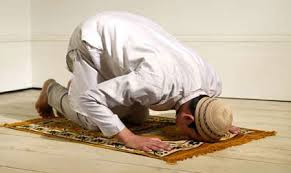
(i) In Sajdah, fingers must be closed (no gap in between fingers), pointing towards the qibla in line with the ears, and the head must be between hands. It is fard to put the forehead on something clean, such a clean stone, clean ground, clean wood or clean cloth and it is wajib to put the nose down too. It is not permissible to put only the nose on the ground without a good excuse. It is makruh to put only the forehead on the ground. Thr nose should be pressured enough so that the bone of nose feel the ground, its very important to keep in account when perfoming salat on a soft carpet.
(ii) In sajda, you say, 'Subhana Rabbiyal A'la' at least thrice.
(iii) It is fard to put two feet or at least one finger of any foot on the ground. If both the feet are not placed on ground, salaat will be annulled and not be accepted.
(iv) It is sunnat to bend the toes and turn them towards the qibla. (v) Men must keep their arms and thighs away from their abdomen.
(vi) Sajda must be done on the ground on condition that you will press on them until you feel their hardness, that is until your forehead cannot move downward any more. Same applies for the nose. Special precaution is required on this issue when peroforming salat on a carpet.
(vii) It is written in 'Halabi': "When going into sajda it is Makruh-e-Tehrimi to pull up the skirts of your loose long robe or your trousers, and it is Makruh-e-Tehrimi to fold them before beginning salaat. It is Makruh-e-Tehrimi to perform salaat with folded sleeves, cuffs or skirt." Special attention is needed on this issue for the people of India and Pakistan who wear Shalwar and Kurta. If pulled or folded one must repeat the Salat.
(viii) It is Makruh to perform salaat with a bare head because of laziness or without realizing the importance of performing salaat with a covered head. For, not to cover one's head means to disobey the ayat: "Take your ornamented clothes and cover yourself for salaat!"
(xi) It is sunnat to wrap a turban (Imama)
around the head whether in white or black color as Rasulullah Salallahu
Alaihi Wasallam used these colours or any other color.
(x) Allama Ibne Abidin Shami Rehmatullahi Ta'ala Alaih said, "Direction towards qibla is fard for salaat. That is, salaat is performed by turning towards the direction of the Ka'aba. Salaat is performed for Allah. Sajda is done for Allah Ta'ala only, not for the Ka'aba. One who makes sajdah for the Ka'aba becomes a disbeliever."
QAI'DA-I-AKHIRA:
Means sitting in the last rak'at. it is fard to sit as long as it takes to say the Athiyyat, "Atthayyato Lillahe Wassalawato Wat Tayyebato Assalamu Alaika Ayyohan Nabiyo Wa Rehmatullahe Wa Barakatoh Assalamu Alaina Wa Ala Ibadillahis Sualaiheen Ashadu An La ilaah illal Laho Wa Ashadu Anna Mohammadan Abdohoo Wa Rasooloohoo" When sitting, men put their left foot flat on the ground with it toes pointing towards the right. They sit on this foot. The right foot should be upright, with the toes touching the ground and bent and pointing towards the qibla.
NOTE 1: Women sit by Tawarruk. That is, they sit with their buttocks on the ground. Their thighs should be close to each other. Their feet should jut out from the right.
NOTE 2: When you reach at Ashadu An La raise your index finger of your right hand upward facing about 45 degrees by closing the fist, and drop it back and spread the hand to its original position at illal Laho.
KHUROOJ BI SUN'EEHI:
To signify the completion of prayer by word or action. It means to finish out prayer by saying or doing something. Salaat is completed by saying, "Assalamo Alaikum Wa Rehmatullah" First by moving head towards right and saying it, then towards left and saying it.
PRAYER AFTER THE SALAAT:
(i) It is mustahab (good) for the imam to turn right or left or towards the jama'at.
(ii) It is stated in a hadith, 'If a person says, "Astaghfirullah Al'azim-il-llazi La ilaha illa Huw-al-hayy-ul-qayyuma Wa Atubu ilayh", after every prayer of salaat, all his sins will be forgiven.
(iii) Imam and the followers raise their hands as high as their chest and pray (Dua) for themselves and for all muslims. A hadith declares, 'Prayers (Dua) sent after the five daily fard will be accepted.' (Tirmidhi). But the prayers (Dua) must be done with a vigilant heart. Not with fingers turned towards the qibla, arms not opened apart in the right-left direction, arms too close to each other, too far forward etc.
(iv) While saying Dua, the fact is that it is mustahab (good) to say salaat and salaam upon RasoolAllah (sallallahu alaihi wasallam),
(v) After making your Prayers (Dua), it is sunnat to rub the hands gently on the face.
(x) Allama Ibne Abidin Shami Rehmatullahi Ta'ala Alaih said, "Direction towards qibla is fard for salaat. That is, salaat is performed by turning towards the direction of the Ka'aba. Salaat is performed for Allah. Sajda is done for Allah Ta'ala only, not for the Ka'aba. One who makes sajdah for the Ka'aba becomes a disbeliever."
QAI'DA-I-AKHIRA:
Means sitting in the last rak'at. it is fard to sit as long as it takes to say the Athiyyat, "Atthayyato Lillahe Wassalawato Wat Tayyebato Assalamu Alaika Ayyohan Nabiyo Wa Rehmatullahe Wa Barakatoh Assalamu Alaina Wa Ala Ibadillahis Sualaiheen Ashadu An La ilaah illal Laho Wa Ashadu Anna Mohammadan Abdohoo Wa Rasooloohoo" When sitting, men put their left foot flat on the ground with it toes pointing towards the right. They sit on this foot. The right foot should be upright, with the toes touching the ground and bent and pointing towards the qibla.
NOTE 1: Women sit by Tawarruk. That is, they sit with their buttocks on the ground. Their thighs should be close to each other. Their feet should jut out from the right.
NOTE 2: When you reach at Ashadu An La raise your index finger of your right hand upward facing about 45 degrees by closing the fist, and drop it back and spread the hand to its original position at illal Laho.
KHUROOJ BI SUN'EEHI:
To signify the completion of prayer by word or action. It means to finish out prayer by saying or doing something. Salaat is completed by saying, "Assalamo Alaikum Wa Rehmatullah" First by moving head towards right and saying it, then towards left and saying it.
PRAYER AFTER THE SALAAT:
(i) It is mustahab (good) for the imam to turn right or left or towards the jama'at.
(ii) It is stated in a hadith, 'If a person says, "Astaghfirullah Al'azim-il-llazi La ilaha illa Huw-al-hayy-ul-qayyuma Wa Atubu ilayh", after every prayer of salaat, all his sins will be forgiven.
(iii) Imam and the followers raise their hands as high as their chest and pray (Dua) for themselves and for all muslims. A hadith declares, 'Prayers (Dua) sent after the five daily fard will be accepted.' (Tirmidhi). But the prayers (Dua) must be done with a vigilant heart. Not with fingers turned towards the qibla, arms not opened apart in the right-left direction, arms too close to each other, too far forward etc.
(iv) While saying Dua, the fact is that it is mustahab (good) to say salaat and salaam upon RasoolAllah (sallallahu alaihi wasallam),
(v) After making your Prayers (Dua), it is sunnat to rub the hands gently on the face.
The Most Honourable Prophet Salla Allahu ta'ala 'alayhi wa Sallam said: Hazrath Gibriel alayhis 'salam came to me with a clean mirror in his hand and said: This is Juma. Allah Subhanahu wa Ta'ala has made it obligatory on you, so that it may be a festival for you and after you for your followers. I Salla Allahu ta'ala 'alayhi wa Sallam said : what good there is for us in it? He said: You have got an suspicious time in it. If a man seeks anything to Allah Subhanahu wa Ta'ala at this time, Allah Subhanahu wa Ta'ala has promised that He will give it to him. If he deprived of that, many aditional things are given to him in that connection. If anyone wants to save himself from any evil on that day, Allah Subhanahu wa Ta'ala saves him from a greater calamity or a like calamity which has been decreed on him. Jumma day is the best day to us and we shall call it in the Resurrection day as the day of grace. I Salla Allahu ta'ala 'alayhi wa Sallam asked him: what object is there in the calling it as the day of grace? He said: Allah Subhanahu wa Ta'ala has made a valley in the paradise made of white musk. When the Jumma day comes, Allah Subhanahu wa Ta'ala descends on His Throne in Illyyin and sheds His Lusture and they look on towards His august face. The Most Honourable Prophet Salla Allahu ta'ala 'alayhi wa Sallam said: The sun rose for the first time on the best Jumma day and Hazrat Adam alayhis 'salam was created on that day. He entered Paradise first on that day and he was thrown in to this world on that day and his pensance was accepted on that day. He Died on this day and Resurrection will take place on this day. This day is a day of blessing of Allah Subhanahu wa Ta'ala. The heavens and the angels have been given names on this day.
There is Hadis-e-shareef that Allah Subhanahu wa Ta'ala will release six lacs of men from Hell on this day. The Most Honourable Prophet Salla Allahu ta'ala 'alayhi wa Sallam said: when the Jumma day is safe, all the days remain safe. He Salla Allahu ta'ala 'alayhi wa Sallam said: If a man dies on the Jumma day or night, the rewards of one martyrdom are written fOR him and the punishment of grave is forgiven.
By the Grace of Allah Subhanahu wa Ta'ala i was also given life(born) on this earth is This Day, and i pray to Allah Subhanahu wa Ta'ala that TO make us More close to the Righteous path with His Most Righteous Men as such i be prepared for This Day. Ameem Ya Rabul Alameen.
Tuesday, July 7, 2015
Conditions for breaking fast in Ramadan
The fast breakers, except menstruation (hayd) and post childbirth bleeding (nifaas), including marital relations, self-pollution, eating and drinking; indulging in them do not break fast and require redemption of the fast unless three conditions are met:
(1) Knowledge (`Elim)
The person should have full knowledge that what he is about to do will invalidate his fast. If he is ignorant and does not know, the fast remains valid. Allah (SWT) said,
“...But there is no blame on you if you make a mistake therein: (What counts) is the intentions of your hearts.” (Al-Qu`ran, 33:5)
Doubt In The Break of Dawn
In the case of the ignorant person mentioned above, he can be either
(a) ignorant of the Islamic rule in the matter, as a person who did not know that a certain act will invalidate fast, or
(b) ignorant of the time, as a person who thinks the dawn has not broken and continues his sahur, finding out later that the sun has risen. Or he mistakenly breaks fast thinking the sun has set. In all these instances, the fast is valid, despite the ruling to the contrary by the majority of the scholars.
In a hadith by Bukhari (raa) when the following verse was revealed:
“...And eat and drink, until the white thread of dawn appears to you distinct from its black thread...” (Al-Qur'an, 2:187)
`Adyi bin Hatim (raa) told the Messenger of Allah (saas) that he placed two threads, one black and the other white, under this pillow as he sat to eat his sahuur. He continued to eat while glancing at the thread under his pillow to see whether he can differentiate between them. By the time he could differentiate between them, it was already daybreak. When he finished this story, the Messenger of Allah commented and explained: `Your pillow must be very vast (to cover the spaces of white and black threads)' What is really meant is the whiteness of the day and the darkness of the night.'
The point of reference in this hadith is that 'Adyi ate after Fajr and after the time he was supposed to stop, but the Prophet (saas) did not ask him to make up the day because he was ignorant of the Shari'ah rule. In another report by Bukhari, Asma bint Abu Bakr (raa) said: “We broke fast one day in Ramadan, on a cloudy evening during the time of the Prophet, but after a while the sun appeared.” Again in this citation there is no report that the Prophet commanded those who mistakenly broke their fast to make up the day. If he had, it would have been reported because of its importance.
Elsewhere, Hisham bin `Urwah (raa), who was one of the reporters of the above hadith, said: “They were not commanded to redeem the day.”
(2) Remembering (Dhikir)
The faster should remember before an act that it will invalidate his fast. If he forgets, the fast remains valid and resumes, as mentioned earlier.
Allah (SWT) states:
“...Our Lord! condemn us not if we forget or fall into error...” (Al-Qur`an, 2:286)
In Islam no one is condemned for an act done out of forgetfulness or due to a mistake. It is human, after all, to forget.
In a hadith mentioned earlier it was observed:
“Whoever forgets while fasting and eats or drinks, he should complete his fast (of that day), for he has just been fed and quenched by Allah.” (Muslim and others)
Thus, regarding the eating and drinking of one who forgets, it is evident that he is not to be held responsible for his action. However, if he remembers or has been reminded, he should stop immediately, for if he continues to eat after that moment, the fast is invalid. Therefore, it is incumbent on anyone who sees a faster eating or drinking to remind him or her.
Allah (SWT) said:
“...Help you one another in righteousness and piety.” (Al-Qur`an, 5:2)
(3) Breaking Fast Willingly (Ikhtiyaar)
For the fast to become invalid, the person should break on his own accord, eating or drinking intentionally without force from anyone. For, if he is coerced under the threat of harm, the fast remains valid. Allah (SWT) states:
“ Anyone who, after accepting faith in Allah, utters unbelief, except under coercion, his heart remaining firm in faith...” (Al-Qur`an, 16:106)
The point of reference here is if Allah absolves one from blame for claiming disbelief under compulsion (a person who has said a word of great sin), a person under similar conditions who has committed lesser offense deserves pardon.
Besides, the Messenger of Allah (saas) said in a hadith related by Ibn Abbas (raa):
“Allah absolves my community (Ummah) from responsibility if they make a mistake, or forget, or have been forced to do something against their own will.” (Ibn Majah)
Relying on this citation, if, for instance, water is mistakenly swallowed during rinsing of the mouth or sniffing, or a person is forced under threat of harm to eat, the fast remains valid.
(1) Knowledge (`Elim)
The person should have full knowledge that what he is about to do will invalidate his fast. If he is ignorant and does not know, the fast remains valid. Allah (SWT) said,
“...But there is no blame on you if you make a mistake therein: (What counts) is the intentions of your hearts.” (Al-Qu`ran, 33:5)
Doubt In The Break of Dawn
In the case of the ignorant person mentioned above, he can be either
(a) ignorant of the Islamic rule in the matter, as a person who did not know that a certain act will invalidate fast, or
(b) ignorant of the time, as a person who thinks the dawn has not broken and continues his sahur, finding out later that the sun has risen. Or he mistakenly breaks fast thinking the sun has set. In all these instances, the fast is valid, despite the ruling to the contrary by the majority of the scholars.
In a hadith by Bukhari (raa) when the following verse was revealed:
“...And eat and drink, until the white thread of dawn appears to you distinct from its black thread...” (Al-Qur'an, 2:187)
`Adyi bin Hatim (raa) told the Messenger of Allah (saas) that he placed two threads, one black and the other white, under this pillow as he sat to eat his sahuur. He continued to eat while glancing at the thread under his pillow to see whether he can differentiate between them. By the time he could differentiate between them, it was already daybreak. When he finished this story, the Messenger of Allah commented and explained: `Your pillow must be very vast (to cover the spaces of white and black threads)' What is really meant is the whiteness of the day and the darkness of the night.'
The point of reference in this hadith is that 'Adyi ate after Fajr and after the time he was supposed to stop, but the Prophet (saas) did not ask him to make up the day because he was ignorant of the Shari'ah rule. In another report by Bukhari, Asma bint Abu Bakr (raa) said: “We broke fast one day in Ramadan, on a cloudy evening during the time of the Prophet, but after a while the sun appeared.” Again in this citation there is no report that the Prophet commanded those who mistakenly broke their fast to make up the day. If he had, it would have been reported because of its importance.
Elsewhere, Hisham bin `Urwah (raa), who was one of the reporters of the above hadith, said: “They were not commanded to redeem the day.”
(2) Remembering (Dhikir)
The faster should remember before an act that it will invalidate his fast. If he forgets, the fast remains valid and resumes, as mentioned earlier.
Allah (SWT) states:
“...Our Lord! condemn us not if we forget or fall into error...” (Al-Qur`an, 2:286)
In Islam no one is condemned for an act done out of forgetfulness or due to a mistake. It is human, after all, to forget.
In a hadith mentioned earlier it was observed:
“Whoever forgets while fasting and eats or drinks, he should complete his fast (of that day), for he has just been fed and quenched by Allah.” (Muslim and others)
Thus, regarding the eating and drinking of one who forgets, it is evident that he is not to be held responsible for his action. However, if he remembers or has been reminded, he should stop immediately, for if he continues to eat after that moment, the fast is invalid. Therefore, it is incumbent on anyone who sees a faster eating or drinking to remind him or her.
Allah (SWT) said:
“...Help you one another in righteousness and piety.” (Al-Qur`an, 5:2)
(3) Breaking Fast Willingly (Ikhtiyaar)
For the fast to become invalid, the person should break on his own accord, eating or drinking intentionally without force from anyone. For, if he is coerced under the threat of harm, the fast remains valid. Allah (SWT) states:
“ Anyone who, after accepting faith in Allah, utters unbelief, except under coercion, his heart remaining firm in faith...” (Al-Qur`an, 16:106)
The point of reference here is if Allah absolves one from blame for claiming disbelief under compulsion (a person who has said a word of great sin), a person under similar conditions who has committed lesser offense deserves pardon.
Besides, the Messenger of Allah (saas) said in a hadith related by Ibn Abbas (raa):
“Allah absolves my community (Ummah) from responsibility if they make a mistake, or forget, or have been forced to do something against their own will.” (Ibn Majah)
Relying on this citation, if, for instance, water is mistakenly swallowed during rinsing of the mouth or sniffing, or a person is forced under threat of harm to eat, the fast remains valid.
Saturday, July 4, 2015
Blessings of Sehari (Suhoor) in Ramadan
Below are the few Blessings of Sehari (Suhoor) in Ramadan. May Allah bless each of us with his blessings. Aameen
» Eat Sahari because it is a blessed (food). [Sahih Bukhari, Vol. 1, Page 633, Hadith 1923]
» The distinguishing factor between us and the people of the book (Ahl al-Kitab) lies in eating Sahari. [Sahih Muslim, Page 552, Hadith 1096]
» Allah and His angels send mercy upon the people who eat Sahari. [Sahih Ibn Hibban, Vol. 5, Page 194, Hadith 3458]
» Eat Sahari to gain strength for fast and take rest (siesta) in the afternoon to gain strength for worshipping at night. [Sunan Ibn Majah, Vol. 3, Page 321, Hadith 1693]
» Sahari is a blessing Allah has granted you (therefore) do not miss it. [Sunan al-Kubra, Nasai, Vol. 2, Page 79, Hadith 2472]
» There are three people who will not be held accountable no matter how much they eat, provided the food is Halal: (a) A fasting person at the time of Iftar. (b) The one who eats at Sahari and (c) A warrior that protects the Islamic border in the path of Allah. [At-Targhib wat-Tarhib, Vol. 2, Page 90, Hadith 9]
» Sahari is full of blessings, so do not miss it even if you drink just a sip of water. Allah and His angels send mercy upon the people who consume Sahari. [Musnad Imam Ahmad, Vol. 4, Page 88, Hadith 11396]
» Sayyiduna Irbad bin Sariyah [Radi Allahu Anhu] has narrated that once the Beloved and Blessed Prophet (SallAllahu Alayhi wa Sallam) called him to eat Sahari with him during the month of Ramadan and said: ‘Come for a blessed breakfast.’ [Sunan Abi Dawud, Vol. 2, Page 442, Hadith 2344]
» Eat Sahari because it is a blessed (food). [Sahih Bukhari, Vol. 1, Page 633, Hadith 1923]
» The distinguishing factor between us and the people of the book (Ahl al-Kitab) lies in eating Sahari. [Sahih Muslim, Page 552, Hadith 1096]
» Allah and His angels send mercy upon the people who eat Sahari. [Sahih Ibn Hibban, Vol. 5, Page 194, Hadith 3458]
» Eat Sahari to gain strength for fast and take rest (siesta) in the afternoon to gain strength for worshipping at night. [Sunan Ibn Majah, Vol. 3, Page 321, Hadith 1693]
» Sahari is a blessing Allah has granted you (therefore) do not miss it. [Sunan al-Kubra, Nasai, Vol. 2, Page 79, Hadith 2472]
» There are three people who will not be held accountable no matter how much they eat, provided the food is Halal: (a) A fasting person at the time of Iftar. (b) The one who eats at Sahari and (c) A warrior that protects the Islamic border in the path of Allah. [At-Targhib wat-Tarhib, Vol. 2, Page 90, Hadith 9]
» Sahari is full of blessings, so do not miss it even if you drink just a sip of water. Allah and His angels send mercy upon the people who consume Sahari. [Musnad Imam Ahmad, Vol. 4, Page 88, Hadith 11396]
» Sayyiduna Irbad bin Sariyah [Radi Allahu Anhu] has narrated that once the Beloved and Blessed Prophet (SallAllahu Alayhi wa Sallam) called him to eat Sahari with him during the month of Ramadan and said: ‘Come for a blessed breakfast.’ [Sunan Abi Dawud, Vol. 2, Page 442, Hadith 2344]
Wednesday, July 1, 2015
Step by Step Method for performing the Eid Prayer (Eid Namaz / Salat)
The method is to make intention for Eid-ul-Fitr or Eid-ud-Duha for two Rakats Wajib and then lift your hands up to your ears and say ‘Allahu Akbar’ and then fold them below the navel as normal.
Now pray ‘Sana’ and then say Allahu Akbar and lift your hands up to your ears and release them and again lift your hands and say Allahu Akbar and release them again and then lift your hands again and say Allahu Akbar and then fold them.
This means fold your hands after the first and fourth Takbeer and in the second and third Takbeers release your hands. The best way to remember is that if the Imam shall recite after the Takbeer then fold your hands and when he shall not recite (after a Takbeer) release your hands and hang them on the side.
After folding your hands after the fourth Takbeer the Imam will silently recite ‘A’udhubillah’ and ‘Bismillah’ and then he will pray Surah al-Fatiha (‘Alhamd Sharif’) and a Surat loudly and then go into Ruku and Sijdah and (thus,) complete one Rak’at (unit).
Then in the second Rak’at the Imam will first pray the Alhamdu and a Surat then lift your hands to your ears and say Allahu Akbar and release them; and do not fold them and repeat this twice. Therefore a total of three times the Takbeer shall be said. On the fourth time say Allahu Akbar and without lifting your hands go into Ruku.
This therefore means that in the Eid prayer there are six extra Takbeers; three before Qira’at (recitation) and after Takbeer-e-Tahrima in the first Rak’at and three after Qira’at in the second Rakat and before the Takbeer for Ruku.
Also in all the extra Takbeers you must lift your hands and between two Takbeers a gap of three Tasbeehs should be made and it is Mustahab in the Eid prayer to recite after Alhamdu, ‘Surah al-Jumu’ah’ in the first Rak’at and ‘Surah al-Munafiqun’ in the second or in the first pray ‘Sabbih Isma Rabbik al-A’la’ and in the second ‘Hal Ataaka Hadeethul Ghasihiyah’. [al-Durr al-Mukhtar Pgs. 113-114, Bahar-e-Shari’at]
Method of performing the Eid prayer has been taken from the English version of the book “Qanoon-e-Shari’at”, by ‘Allama Shamsul ‘Ulama Shamsuddin Ahmed al-Radawi, the student of Sadr al-Shari’ah, Allama Mufti Amjad ‘Ali al-‘A’azmi.
SUREHS TO BE READ IN NAMAZ
SURAH AL-FATIHA
Alhamdul lil-lahi rab-bil 'alameen
Ar rahma nir-raheem
Maliki yawmid-deen
Iyyaka na'budu wa iyyaka nasta'een
Ihdinas siratal mustaqeem
Siratal Lazeena an'amta 'alayhim
Ghai-ril maghdubi 'alayhim
Walad dal-leen. Ameen.
SURAH AL-IKHLAS
Qul huwal lahu ahad.
Allah hus-Samad.
Lam yalid walam yulad.
Walam yakul-lahu Kufuwan ahad.
SUREH QADR
Innaa Anzalnaahu Fee Lailatil Qadr
Wa Maa Adraaka Ma Lailatul Qadr
Lailatul Qadri Khairum Min Alfee Shahr
Tanaz Zalul Malaa-ikatu War Roohu Feeha Bi Izni-rab Bihim Min Kulli Amr
Salaamun Hiya Hattaa Mat La'il Fajr
SUREH NASR
Iza Jaa-a Nas Rullahi Walfath
Wa Ra-aitan Naasa Yadkhuloona Fee Deenil Laahi Afwajah
Fa Sab Bih Bihamdi Rabbika Was Taghfir, Innahu Kaana Tawwaaba
AYTAL KURSI
Allahu laaa ilaaha illaa huwal haiyul qai-yoom; laa taakhuzuhoo sinatunw wa laa nawm; lahoo maa fissamaawaati wa maa fil ard; man zallazee yashfa'u indahooo illaa be iznih; ya'lamu maa baina aideehim wa maa khalfahum; wa laa yuheetoona beshai 'immin 'ilmihee illa be maa shaaaa; wasi'a kursiyyuhus samaa waati wal arda wa la ya'ooduho hifzuhumaa; wa huwal aliyyul 'azeem
اللَّهُ لاَ إِلَهَ إِلاَّ هُوَ الْحَيُّ الْقَيُّومُ لاَ تَأْخُذُهُ سِنَةٌ وَلاَ نَوْمٌ لَهُ مَا فِي السَّمَاوَاتِ وَمَا فِي الأَرْضِ مَنْ ذَا الَّذِي يَشْفَعُ عِنْدَهُ إِلاَّ بِإِذْنِهِ يَعْلَمُ مَا بَيْنَ أَيْدِيهِمْ وَمَا خَلْفَهُمْ وَلاَ يُحِيطُونَ بِشَيْءٍ مِنْ عِلْمِهِ إِلاَّ بِمَا شَاءَ وَسِعَ كُرْسِيُّهُ السَّمَاو ;َاتِ وَالأَرْضَ وَلاَ يَئُودُهُ حِفْظُهُمَا وَهُوَ الْعَلِيُّ الْعَظِيمُ
ATTAHIYAT
AttahiyyaatuLillahi Was Salawatu Wattayyibatu
Assalamu Alaika Ayyuhannabi 'yu 'Warahmatullahi Wabarka'tuhu
Assalamu Alaina Wa'ala'Ibadillahis Saa'liheen
Ash'had'u'un La ilahaillallahu
Wa Ash'hadu Anna MuhammadunAbd'uhu Wa Rasooluhu
DAROOD-E-IBRAHIM
Allahumma Salleh Ala Sayyidina Muhammadin Wa'ala' Aale Sayyidina Muhammadin Kama Sallaiyta Ala Sayyidina Ibraheema Wa' Ala Aale Sayyidina Ibraheema InnakaHameedum Majeed -Allahumma Baarak Ala Sayyidina Muhammadin Wa' Ala Aale Sayyidina Muhammadin Kama Baarakta Ala Sayyidina Ibraheem Wa' Ala Aale Sayyidina Ibraheema Innaka Hameedum Majeed
Then Read the below Dua
Allahumag Firii Wali Wale Dayya Wal Ustaad'e Wal Jamee'il Mu'mineena Wal Mu'meenat Wal Muslimeena Wal MuslimatAI'Ahya'eMinhum Wal Amwaat'e Innaka MujeebudDa'waatBirahmatikaYa Ar'hamarr'ahimeen'
or pray another Dua-e-Ma'soor or pray
'Allahumma Rabbana Aatina Fid DuniyaHasanatawWafil Akhirati Hasanataw Wa QinaAzaabanNaar'
DUA QUNOOT (READ IN 3RD RAKAT OF WITR IN ISHA)
Allah humma inna nast'eenuka wa nastaghfiruka
wa nu'minu bika wa natawak-kalu 'alayka wa nuthne 'alayk-al khayr.
Wa nashkuruka wa laaa nakfuruka wa nakhla'u wa natruku man-y yafjuruka.
Allah humma iyyaka na'budu wa laka nusal-lee
wa nasjudu wa ilayka nas'a wa nahfidu wa narju rahmataka
wa nakhsha 'azabaka inna 'azabaka bil kuf-fari mulhiq.
Hadiths on Eid Prayers or Namaz
I. Hadrat Anas reported that when the Holy Prophet came to Madinah, the people had two days in which they used to entertain and amuse themselves. He asked: “What are these two days?” They said: “We used to amuse ourselves and take pleasure in these two days during the Days of Ignorance (jahiliyyah). The Messenger of Allah said, “Allah has substituted for you something better than these two; the Eid of Adha (sacrifice) and the Eid of Fitr . [Sunan Abi Dawood - Book on Prayer, Vol 1, Page 162]
II. Hadrat Abu al-Huwairith reported that the Messenger of Allah wrote to Hadrat ‘Amr ibn Hazm, when he was in Najran, asking him to observe the prayer early on the Eid of Adha (sacrifice) and late on the Eid of Fitr, and to admonish the people. [Mishkaat - Book on Prayer, Vol 1, Page 127]
III. Hadrat Jabir ibn Samurah reported, “I prayed with the Messenger of Allah the two Eid prayers more than once or twice, without an Adhan or Iqamah.” [Sahih Muslim - Book on the two Eid Prayers, Vol 1, Page 290]
IV. Hadrat Anas reported that the Messenger of Allah did not go (to the place of prayer) in the morning on the day of Eid-ul-Fitr till he ate some dates, and he used to eat an odd number. [Sahih Bukhari - Book on the two Eid Prayers, Vol 1, Page 130]
V. Hadrat Buraidah reported that the Holy Prophet did not go out on the day of Eid-ul-Fitr till he had eaten some food; and that he did not eat any food on the day of Eid-ul-Adha (sacrifice) till he had prayed. [Sunan Tirmidhi - Book on the two Eid Prayers, Vol 1, Page 120]
VI. Hadrat Jabir reported that on the day of Eid the Holy Prophet used to return by a different route from the one he had taken when going out. [Sahih Bukhari - Book on the two Eid Prayers, Vol 1, Page 134]
Post your Comments
#Islamic Calendar 2025 Events
| Islamic 2025 Event Name | English Date | Islamic Date |
| Urs Haji Malang | January 2, 2025 - Thursday | 10 Jumada al-Akhirah 1446 |
| Urs Haji Ali Baba Mumbai | January 4, 2025 - Saturday | 12 Jumada al-Akhirah 1446 |
| 721st Urs Sharif Of Hazrat Khwaja Syed Nizamuddin Aulia Mehboob-e-Elahi Rahmatullah Alayh | January 7, 2025 - Tuesday | 15 Jumada al-Akhirah 1446 |
| Urs Khwaja Gharib Nawaz, Ajmer Sharif | March 24, 2025 - Monday | 22 Sha'ban 1446 |
| Lailat al-Miraj (Shab-e-Meraj) | January 27, 2025 - Monday | 27 Rajab 1446 |
| Shab-e-Barat | February 14, 2025 - Friday | 15 Sha'ban 1446 |
| Start of Fasting Month (Ramadan) | March 1, 2025 - Saturday | 1 Ramadan 1446 |
| Lailat al-Qadr (Shab-e-Qadr) | March 27, 2025 - Thursday | 27 Ramadan 1446 |
| Jummat-ul-Wida | March 28, 2025 - Friday | 28 Ramadan 1446 |
| Eid-ul-Fitr | March 30, 2025 - Sunday | 1 Shawwal 1446 |
| #Hajj | June 6, 2025 - Friday | 9 Dhul-Hijjah 1446 |
| Eid-ul-Adha (Bakrid) | June 7, 2025 - Saturday | 10 Dhul-Hijjah 1446 |
| Islamic New Year | July 28, 2025 - Monday | 1 Muharram 1447 |
| Yaum al-Ashura | August 6, 2025 - Wednesday | 10 Muharram 1447 |
| Eid Milad-un-Nabi | September 26, 2025 - Friday | 12 Rabi-al-Awwal 1447 |