Monday, August 24, 2009

Ramadan Dua - Day6 of Ramadan Month

Ramadan Dua - Day6 of Ramadan Month

Read the below Dua on 5th day of Ramadan Dua

ALLAAHUMMA LAA TAKHD’ULNEE FEEHI LI-TA-A’RRUZ”I MAA’ –SIYATIKA WA LAA TAZ”RIBNEE BI-SIYAAT’I NAQIMATIKA WA ZAH’ZIH’NEE FEEHI MIN MOOJIBAATI SAKHAT’IKA BI-MANNIKA WA AYADEEKA YAA MUNTAHAA RAGHBATIR RAAGHIBEEN

O Allah do not leave me helpless in the lurch, during this month, because of my transgressions, a forsaken soul exposed to loose; do not let the whipping crack my back, remove and chase away from me the causes and reasons that bring down Thy displeasure instead of bringing in Thy bounties and favours, O the Beloved Craving of those who ardently desire and long for.

Recite a 2 Rak-a’t Salaat (Namaz of Shukranah) in the memory of Imam Ali bin Moosa Ar Rizaa (A.S.) as under:
In every Rak-a’t, after the recitation of Soorah Al Faatih’ah, recite Sooorah Al Ikhlaas 20 times


Read: Dua for Iftar and Sehri in Ramadan / Ramazan

Also Read Daily Dua for Holy Month of Ramadan


Ramadan Dua - Day5 of Ramadan Month

Ramadan Dua - Day5 of Ramadan Month

Read the below Dua on 5th day of Ramadan Dua


ALLAAHUMMAJ-A’LNEE FEEHI MINAL MUSTAGHFIREEN WAJ-A’LNEE FEEHI MIN I’BAADIKAS’S’AALIH’EENAL QAANITEEN WAJ-A’LNEE FEEHI MIN I’BAADIKAS’ S’AALIH’EENAL QAANITEEN WAJ-A’LNEE FEEHI MIN AWLIYAAA-IKAL MUQARRABEEN BIRAAFATIKA YAA ARH’AMAR RAAH’IMEEN
O Allah let me be, in this month, from among those who turn repentant and ask forgiveness for their sins; let me be from among those who do good and obey (Thee); let me be from among those who are Thy close friends, through Thy kindness O the Most Merciful.

Pray a 2 Rak-a’t Salaat as under:
In every Rak-a’t after the recitation of Soorah Al Faatih’ah, recite Soorah Al Ikhlaas 50 times : and after the Salaam say “Salawaat” 100 times.


Read: Dua for Iftar and Sehri in Ramadan / Ramazan

Also Read Daily Dua for Holy Month of Ramadan


Ramadan Dua - Day4 of Ramadan Month

Ramadan Dua - Day4 of Ramadan Month

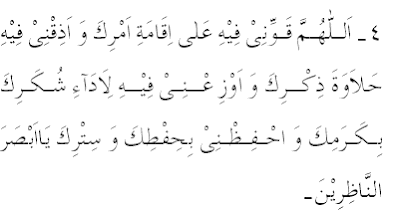
Read the below Dua on 4th day of Ramadan

ALLAAHUMMA QAWWINEE FEEHI A’LAA IQAAAMATI AMRIKA WA AD’IQNEE FEEHI H’ALAAWATA D’IKRIKA WA AWZIA’-NEE FEEHI LI-ADAAA-I SHUKRIKA BIKARAMIKA WAH’-FAZ’NEE FEEHI BI-H’IFZ’IKA WA SITRIKA YAA ABS’ARAN NAAZ’IREEN

O Allah make me stronger to carry out Thy commands, in this month, let me taste the sweetness of Thy praise, put me in the mood of giving thanks to Thee, and protect me with Thy most reliable cover, O the discerning Perceiver.

Salaat
Pray an 8 Rak-a’t Salaat as under:
In every Rak-a’t after the recitation of Soorah Al Faatih’ah, recite Soorah Al Qadr 20 times

Read: Dua for Iftar and Sehri in Ramadan / Ramazan

Also Read Daily Dua for Holy Month of Ramadan

Ramadan Dua - Day 3 of Ramadan Month

Ramadan Dua - Day 3 of Ramadan Month

Read the below Dua on 3rd day of Ramadan

ALLAAHUMMAR-ZUQNEE FEEHID’ D’IH-NA WAT TANBEEHA WA BAA-I’DNEE FEEHI MINAS SAFAAHATI WAT TAMWEEKHI WAJ-A’L LEE NAS’EEBAN MIN KULLI KHAYRIN TANZILU FEEHI BIJOODIKA YAA AJWADAL AJWADEEN

O Allah keep me alive, in this month, in a state of alertness and watchfulness; and keep me away from impudence and cynicism, let me share everything good there is in this months, which is in plenty, O the Liberal Most Beneficent.

Salaat
Pray a 10 Rak-a’t after the recitation of Soorah Al Faatih’ah, recite Soorah Al Ikhlaas 50 times

Read: Dua for Iftar and Sehri in Ramadan / Ramazan

Also Read Daily Dua for Holy Month of Ramadan

Friday, August 21, 2009

Things to be avoided in Fasting during Ramadan

Things to be avoided in Fasting during Ramadan

Fasting is one of the best acts of worship. It is mandated by Al­lah (SWT) to purify the soul along with the practice of good deeds. Thus the faster ought to be aware of acts or behaviors that may spoil his fast so that he or she will attain the highest benefit physically and spiritually.

Fasting is not only restraining oneself from fast-breakers ­food, drink and sex -that restrain only the mouth and the pri­vate parts. Every limb (jawarih) must be restrained. The tongue must desist from slander and back-biting. The eyes must re­strain themselves from any unlawful look. The hand must not touch or take what does not belong to it. The ears must not lis­ten to idle talk, gossip, lyrics and notes that contain obscene and indecent things; the nose must fast also by not sniffing, smelling unlawful things. The feet must fast by not going to places where sinful acts are propagated.

When you eat sahuur and iftar, make sure the food on the table has been obtained lawfully. If the servant has observed the fast in these terms and acted accordingly, he or she will have
gained positively by Ramadan and will receive the maximum reward. Hence, fasting is a state of mind that transcends the physical restraint.

In a hadith by Abu Hurairah, the Messenger of Allah (saas) said:

“It is not fasting, just to restrain from food and drink, instead the fast is to cease from idle talk, ob­scenity, and should anyone insult or provoke you, or act ignorantly towards you, respond to it by saying, ‘I am fasting, I am indeed fasting.’ ” (Ibn Khuzaimah)

In another citation reported by Abu Hurairah (raa) the Messen­ger of Allah, (saas), said:
“He who does not stop from false talk or stop from act­ing upon false talk, Allah will have no need that he ab­stain from his food and drink.” (Bukhari)

Again, in the same spirit, the Messenger of Allah (saas) said:
“Many an observer of fasting will not receive from his fasting any reward but the pain of hunger, and many a night worshipper will not receive any reward from his prayer but the loss of sleep.” (Nasaie and Hakim)

These three ahadith are evidence that the most important thing in the eyes of the Lawgiver is not merely physically restraining from the obvious food and drink, but the total commitment of the servant's body and soul to the letter and spirit of fasting. The curfew of the body and mind during the state of fasting enables the person who has fasted in the true spirit of Ramadan to have the necessary requirements to withstand the turbulence of life for the next eleven months.

When the Messenger of Allah (saas) said in the hadith,
“Allah will have no need...” (Bukhari)

He was indicating the depth or seriousness of this case. If you fail the test, Allah will have no need that he abstained... in that test. If Allah rejects the test, who else will accept it? Nobody! Hence, the pain of hunger and the burning of thirst will go un­rewarded.
What Constitutes Suhoor?

What Constitutes Suhoor?

Suhoor can be achieved by a large meal, a small meal, or even by a sip of water or soup.
In a report by Abu Sa'eed Al-Khudri (RAA) the Messenger of Allah (PBUH) said,
“Sahuur is a blessed meal, do not neglect it even if it is a mouthful of drink. For Allah and the Angels bless those who observe it.” (Ahmed)

You see, what reaches Allah is the intent that you have made a genuine effort to obey Allah in fasting. This is why it is rec­ommended to make intention with the sahuur, to emulate the Prophet, and to eat the food to gain strength and energy during fasting, so as to get the reward from Allah. The hadith also contains the information that during the course of this meal the faster receives a special blessing that cannot be found else­where: that Allah (SWT) blesses your meal and that the angels seek on your behalf forgiveness for you during sahuur. Thus, with sahuur you receive both physical and spiritual blessings.

Time of Suhoor

The time for sahuur begins from midnight until the break of dawn. It is recommended, however, to delay it till shortly be­fore the time of Subh (morning) prayer.

In a hadith by Zaid bin Thabit (raa) he related that:
“We ate sahuur with the Messenger of Allah (saas) then we went to pray Subh. I asked the Messenger ‘What was the time period between sahur and prayer?’ He re­sponded ‘The time period between them is the equiva­lent of the time it takes to recite fifty verses in Al-Qur'an.’ ” (Bukhari and Muslim)

This citation is instructive in that it settles the question of whether one should stop eating before morning prayer (Subh/Fajr), or before sunrise, as we see in certain prayer times tables showing the so-called shuruq (the sunrise, which some think is the time to stop eating). The hadith is explicit. The rec­ommendation to delay Sahuur is only to the hour or so before (Subh). The mentioning of the period of recitation of fifty verses (ayats) is a cushion or a grace period in which food or drink should not be taken. All the reports that recommend de­lay of Sahuur must be understood in this way.

During the time of the Messenger of Allah (saas), the tradition of two adhans (or call to prayer) was established, and it has continued up until now in some Muslim countries. The first adhan is to indicate the beginning of sahuur: the adhan of Ab­dullah Ibn Umm Maktum (raa). The second is the adhan of Bi­lal Ibn Rabah (raa): the adhan of Salaah, a morning prayer.

However, if you hear the second adhan while you are eating or drinking, you should immediately stop eating in preparation for fasting.
What are the Rules of Fasting during Ramadan

What are the Rules of Fasting during Ramadan

In Islam, for any act of worship to be valid and acceptable, it must be observed in accordance with the instruction of Allah (SWT) and the practice of the Messenger of Allah (saas). Ob­viously, we did not know about the fasting until we were told about it. It would be unwise to just decide to fast in the way one wishes. That is why there are in Islamic Law (Shari'ah) rules of fasting (Adab As-Siyam). Observation of these rules helps the devotee maximize the physical as well as spiritual benefits of fasting.

They are:

Sahuur (Sehri)

This is a light meal taken shortly before the break of dawn. There is consensus that this meal is a highly recommended Sunnah.

In reports by Bukhari and Muslim, Anas (raa) related that the Messenger of Allah said:

“Take your early morning meal for in that is a bless­ing.”

In another report by Miqdam bin Ma'a Diyikarib (raa) the Mes­senger of Allah (saas) said:
“Take this early morning meal for it is a blessed meal.”

In both hadiths the statement underscores the importance of sahuur, and to caution anyone from thinking they can just stay without a meal all night and continue with fasting. This may explain why the statement came as a command. Although it is not mandatory to eat sahuur, it is highly encouraged so that anyone intending to fast will make an effort to take sahuur.

Iftar

It is recommended also to break the fast with fresh dates, rutub, and in odd numbers, or tamr, regular table or supermarket dates, or water. If dates are not available, any fruit will do. If there is no food or drink to break the fast with, intend in your heart to break fast, and whenever food is available you should eat.

In a report by Anas (raa), he said:
“The Prophet (saas) used to break fast with fresh, ripe dates rutub, before he offered his Maghrib prayer. If they were not available, he would break with regular dates, or drink water if there were no dates.” (Abu Dawud Tirmidhi)

In this report, there is an indication that with the Messenger of Allah (saas) breaking fast precedes evening prayer, Maghrib, as if to say the last meal before fast precedes the morning prayer. Likewise, the first meal at the time of iftaar, the fast breaking meal, precedes evening prayer, Maghrib. Hence, the procedure at Iftaar goes like this: break with a light meal, pref­erably dates, make Iqamah for Maghrib prayer, then take your regular meal.

The meal, may be taken with the family at home, or friends and relatives may be invited to the Iftaar as we shall see that chari­table works are highly recommended in the month of Ramadan. Over the years phenomenon have evolved in different masajid, and Islamic Centers in the United States of America and else­where, where arrangements are made by the believers to break fast in jama'ah in the masajid. These gatherings are excellent and are encouraged as they lead to Taraweeh prayer in Ja­maa`ah in the masjid.
Permission Regarding Voluntary Fast

Permission Regarding Voluntary Fast

The observer of voluntary fasting is his own leader. That is why he is permitted, if he so desires, to abort the fast. This is the verdict of many scholars relying on the evidence of the fol­lowing citations.

Umm Hanee (raa) related that,

“The Messenger of Allah entered into my quarters the day that Makkah was conquered. He was offered water to drink. He drank and passed it to me. I told him I was fasting! The Messenger (saas) instructed. ‘The observer of a voluntary fast is the leader of his own self. If he wishes, he can continue the fast, and if he wants he can break.’ ” (Ahmad)

Elsewhere, Abu Sa'eed Al-Khudri (raa) said,

“I invited the Messenger of Allah (saas). He came with his companions. When the food was brought, a man re­fused to eat. He said, ‘I am fasting.’

The Messenger of Allah (saas) commented: ‘Your brother invited you and he has taken the trouble and incurred the cost for your sake. Break your fast and make it up with another day if you want.’ ” (Bayhaqi)

These two hadiths are evidence that the voluntary fast is dif­ferent from the mandatory fast in that the observer is allowed with or without a valid reason to abort the obligation of fasting. However, the second report shows also that it is desired to make up the aborted day.
Fasting and Breaking Fast

Fasting and Breaking Fast

Some devoted believers may wish to fast forever, oblivious to hardship in their life, not to mention the fact that this type of fasting is not in harmony with the spirit of Al-Islam. When re­ports of Abdullah Bin `Amru's continuous fasting reached the Messenger of Allah (saas), Abdullah related later:

“The Messenger told me, ‘I have been informed that you observe night prayer and a daily fast.’

Ibn Amru answered, Yes! O Messenger of Allah.’

The Messenger advised, him: ‘Fast a day and break a day. Pray at night and sleep. For your body has rights over you, your wife has rights over you, and your guest has rights over you. Indeed, it will per­fectly suffice you to fast three days in every month.’

Amru strongly pointed out that he was capable of observing the fast in the fashion he was doing. But the Messenger advised against it.

Ibn 'Amru said, ‘Then I explained to him that I have the strength to do it.’

The Messenger of Allah (saas) then said: ‘Observe three days fasting starting from Friday (and then break).’

Ibn 'Amru said: ‘I strongly stressed to him that I could, and he vigorously said I should not.’

The Messenger of Allah then instructed, ‘Observe your fast as the Prophet of Allah, Dawud, (David, as), used to observe and do not exceed it.’

‘How did he fast?’ 'Amru asked.

The Prophet (saas) said: ‘Prophet Dawud (as) used to fast a day and break the next.’ ” (Ahmad)

This hadith is instructing and revealing that the objectives in the command to fast are not to unduly injure, or deny the body the natural way of living. It also indicates the caring side of this Messenger of mercy as he tried to convince Amru that his deci­sion to spend the rest of his life in fasting was not in harmony with Islam. With continuous fasts one loses the physical and spiritual benefits. Physically, because it becomes a routine and the body loses the benefits of the way the fast is structured. Spiritually, one feels the numbness, and boredom of the heart. The spouses' right to marital association is denied as the con­tinuous fasting decreases the sexual desire.

The soul is affected only by what intrudes upon it, not by what it is accustomed to. Do you not see that the doctors will advise a person not to take a drug, as a matter of routine, unless the body needs it, lest the same drug will be ineffective when the person gets sick.

The hadith indicates that no one has the right to use his or her body exclusively in the way they desire. In every undertaking, one should bear in mind the other legal rights. The responsibili­ties of a person are multiple. For while you may think you are worshipping Allah, you may well be violating Allah's rules, because you lose the balance in worship by infringing on the rights of your body when you overly deny it the element of survival.

If you fail to fulfill the marital covenant towards your wife or husband, you may be making her or him vulnerable and sus­ceptible to unlawful, immoral acts. The Hadith also reveals and indicates the beautiful relationship between the teacher and the student, and how the Messenger was very patient with a com­panion who had unlimited energy, and did not mind spending it in fasting.

It reveals how the Prophet (saas) encouraged the be­lievers to express their opinions and ask questions while ob­serving the etiquette of respect to the Messenger of Allah (saas) who said:
“The best (voluntary fast in the sight of Allah) is the fast of Prophet Dawud, and the best nightly voluntary prayer is the prayer of Prophet Dawud.”

The Messenger explained,
“He used to sleep half of the night then pray one-third of the night, then sleep one sixth of the night. In fasting, he used to fast a day and break the next.” (Ahmed)

It is a mercy from Allah (SWT) that our Prophet Muhammad (saas) is in tune with all the previous revelations' as we see in Al-Qur'an and the Sunnah. It is rich spiritual information made available through him (saas) to this Ummah.

Thursday, August 20, 2009

Things to avoid during E’tikaf

Things to avoid during E’tikaf

Things to avoid during E’tikaf:

1. Having sex and also according to Ehtiyat kissing or playing with one’s wife.

2. According to a necessary Ehtiyat causing a semen discharge.

3. And smelling perfumes for enjoyment; it is not an offense if one cannot enjoy the perfume because of some defect in his smelling ability.

4. Selling or buying in the form of a business deal, according to a necessary Ehtiyat; there is no offense to be occupied with allowable activities as sewing or writing etc., although it is a Mustahab Ehtiyat to avoid them too.
If one needs to buy something for food and there is no one to do the buying for him, it is not an offence for him to do it.

5. Expressing bitterness in talking about worldly or religious matters in order to prove one’s ability, not the truth which is one of the best worships.

The contracts of buying or selling during E’tikaf invalidate E’tikaf, but such contracts will be valid. If E’tikaf is invalidated because of having sex even, during the night, expiation will be due; if it is invalidated by other things, there will be no expiation, although it is a Mustahab Ehtiyat in this case too.

The expiation for invalidating an E’tikaf is to set free a slave or if this is not possible, fast for two
consecutive months or if this also is not possible, feed sixty (60) poor people.

Also Read:
What is E’tikaf?

Post your Comments

#Islamic Calendar 2025 Events

Islamic 2025 Event Name English Date Islamic Date
Urs Haji Malang January 2, 2025 - Thursday 10 Jumada al-Akhirah 1446
Urs Haji Ali Baba Mumbai January 4, 2025 - Saturday 12 Jumada al-Akhirah 1446
721st Urs Sharif Of Hazrat Khwaja Syed Nizamuddin Aulia Mehboob-e-Elahi Rahmatullah Alayh January 7, 2025 - Tuesday 15 Jumada al-Akhirah 1446
Urs Khwaja Gharib Nawaz, Ajmer Sharif March 24, 2025 - Monday 22 Sha'ban 1446
Lailat al-Miraj (Shab-e-Meraj) January 27, 2025 - Monday 27 Rajab 1446
Shab-e-Barat February 14, 2025 - Friday 15 Sha'ban 1446
Start of Fasting Month (Ramadan) March 1, 2025 - Saturday 1 Ramadan 1446
Lailat al-Qadr (Shab-e-Qadr) March 27, 2025 - Thursday 27 Ramadan 1446
Jummat-ul-Wida March 28, 2025 - Friday 28 Ramadan 1446
Eid-ul-Fitr March 30, 2025 - Sunday 1 Shawwal 1446
#Hajj June 6, 2025 - Friday 9 Dhul-Hijjah 1446
Eid-ul-Adha (Bakrid) June 7, 2025 - Saturday 10 Dhul-Hijjah 1446
Islamic New Year July 28, 2025 - Monday 1 Muharram 1447
Yaum al-Ashura August 6, 2025 - Wednesday 10 Muharram 1447
Eid Milad-un-Nabi September 26, 2025 - Friday 12 Rabi-al-Awwal 1447