Tuesday, June 7, 2016

How to perform Taraweeh Salat with Taraweeh Tasbih

How to perform Taraweeh Salat with Taraweeh Tasbih

All you want to know about Taraweeh Salat.


Tarawih Salat is Sunnat-e-Maukida also called Ramadan Night Prayer and is of 20 Rakats. This is prayed after farz Namaz of isha every night of Ramadan. In this Salat, Holy Quran is Completed.

There are lot of misconceptions regarding how many rakats are of Taraweeh. We have collected all the proof from the Hadiths and the books of the Islamic Scholars to give you enough proof about the Taraweeh Namaz.


Imam Baihaqi has reported through proper testimonies (Saheeh Asnad) from Saeb bin Yazeed (may Allah be pleased with him) that people used to offer 20 Cycles (Rakaats) for the Taraweeh Prayer during the caliphate of Syedna Umar Farouk and this was the norm even during the caliphates of Syedna Osman and Syedna Ali (may Allah be pleased with them).

Taraweeh Niyaat

In English: Make intention of Sunnat-e-Maukida for the sake of Allah, faciing towards Kaaba, Behind the Imam and say "Allahu Akbar "

In Hindi: Niyaat ki maine 2 rakat Sunnat-e-Maukida wasste Allah Ta'alla ke, muhh mera taraf kaa'ba sharif ke taraf, piche is Imam ke Allahu Akbar

The Taraweeh should be offered in Cycles (Rakaats) of two each. After every 4 Cycles, it is recommended to sit for approximately the time it take to offer 4 Cycles. While sitting, one may keep quiet or recite the Kalemah, or the Salutations or recite the following “Tasbeeh”:

Taraweeh Salat Tasbih

Subhanal Malikil Quddus;
Subhana dhil Mulki wal Malakuti;
Subhana dhil izzati wal aDhmati wal haybati wal Qudrati;
wal kibriyaa’i wal jabaroot;
Subhanal Malikil hayyil ladhi, la yunaamu wa layamutu;
Subbuhun, Quddusun, Rabbuna Rabbul malaa’ikati war-rooh;
Allahumma Ajirnee Minan Naar;
Ya Mujeero, Ya Mujeero, Ya Mujeer.

“Pure is He (Allah), the Owner of the Kingdom and the Sovereignty; Pure is He, the Owner of Honour, and Greatness, and Reverence, and Power, and Superiority, and Might; Pure is the Real King Who is Alive - there is neither sleep nor death for Him; He is the Utmost Pure, and the Holy, the Master of all Angels and of the Spirit; O Allah !! Save us from the fire – O Saviour, O Emancipator, O Protector !!”


Reciting the entire Quran in the Taraweeh is an emphasised Sunnah (Muakkadah). Completing it twice is better and thrice is best. It is obligatory upon the “Imaam” or the Memoriser (Hafiz) to recite the Quran with proper pronunciation. Charging money or fixing wages for leading Taraweeh Prayers is also not permitted - the payer and the receiver of such compensation, both are sinners.

The time for Taraweeh is after the Obligatory (Farz) Night (Isha) Prayers and lasts up to dawn. If one does not offer the Night Prayer with the congregation, he must offer it alone and then join the Taraweeh congregation. However he must offer the Witr Prayer alone, without congregation. It is better to offer the Taraweeh in the mosque, alongwith the congregation.

Hadiths on 20 Rakats Taraweeh from Concrete Sources

1) Imam Tirmidhi states:

The majority of the scholars practice what has been transmitted from Hadrat ‘Umar Faruq, Hadrat ‘Ali and the other companions that Tarawih is twenty rak’ats. Imam Sufiyan al-Thawri, Imam ‘Abdullah ibn Mubarak and Imam al-Shafi’i have stated the same (that Tarawih is twenty rak’ats). Imam Shafi’i has stated that we have found the residents of our city Makkah al-Mukarramah performing twenty rak’ats for the Tarawih prayer. [Tirmidhi – Chapter on worshipping the nights of Ramadhan – Page 99]

2) Imam Mulla ‘Ali al-Qari has stated:

It is the conformity of all the muslims upon the twenty rak’ats for Tarawih. This is because Imam Baihaqi narrates with a sound chain of transmission that in the blessed era of Hadrat ‘Umar, Hadrat ‘Uthman and Hadrat ‘Ali, the companions and all those who followed them (Tabi’un) performed twenty rak’ats for the Tarawih prayer. [Babu Fath al-‘Inayah Sharh al-Nuqayah]

3) It has been stated in the commentary of Tahtawi on Maraqiy al-Falah that:

By the continuous practice of Hadrat Abubakr al-Siddiq and the other Rightly-Guided Caliphs, it has been proven that Tarawih is twenty rak’ats. [Page 224]

4) ‘Allama ibn ‘Abidin al-Shami states:

Tarawih is twenty rak’ats; this is the ruling of the majority of the scholars and the common practice of all Muslims from east till west. [Radd al-Muhtar – Vol. 1, Page 195]

5) Imam al-Ghazzali states:

Tarawih is twenty rak’ats. [Ihya ‘Ulum al-Din – Vol. 1, Page 201]

6) In Sharh al-Waqaya it has been stated:

Twenty rak’ats for the Tarawih is the Sunnah. [Vol. 1, Page 175]

7) In Fatawa-e-‘Alamgiri (also known as “al-Fatawa al-Hindiyyah”) it states:

Tarawih consists of five Tarweha; each tarweha is four rak’ats with two salaams (made at the end of two rak’ats). This has also been stated in al-Sirajiyyah. [Vol. 1. Page 108]

8) Shah Waliyullah Muhaddith-e-Dehlwi states:

The number of rak’ats for the Tarawih is twenty. [Hujjatullahil Baligha – Vol. 2, Page 18]

More Hadiths on 20 Rakats Taraweeh 

1) Hadrat Abu Hurairah reported that the Messenger of Allah has said,

من قام رمضان إيمانا واحتسابا غفر له ما تقدم من ذنبه
“…whoever prays during the night in Ramadhan sincerely; seeking his reward from Allah, his former sins are forgiven.” [Sahih al-Muslim, Vol. 1, Page 259, Hadith 1815]

2) Hadrat Sa’ib ibn Yazid has stated that,

كانوا يقومون على عهد عمر بن الخطاب رضى الله عنه فى شهر رمضان بعشرين ركعة
“We, (the Companions of the Beloved Prophet,) used to pray twenty rak’ats Tarawih prayer in the era of the Caliph ‘Umar ibn al-Khattab.” [Sunan al-Bayhaqi, Vol. 2, Page 224, Hadith 4801]

3) It has been stated in Mirqat al-Mafatih:

إسناده صحيح
The chain of narration of this Hadith is sound (Sahih). [Mirqat al-Mafatih – Vol. 2, Page 175]

4)Hadrat Yazid ibn Ruman reports that

كان الناس يقومون فى زمان عمر بن الخطاب فى رمضان بثلاث وعشرين ركعة
“...during the time of Hadrat ‘Umar ibn al-Khattab, people used to pray 23 Rak’ahs during Ramadhan (20 rak’ahs for Tarawih prayer and 3 rak’ats for witr.)” [Muwatta Imam Malik, Vol. 1, Page 115, Hadith 251]

5) Sayyiduna Ibn Abbas Radi Allahu Ta'ala Anhu narrates, said that,

أن النبي صلى الله عليه وسلم كان يصلي في رمضان عشرين ركعة سوى الوتر
During the month of Ramadhan, aside from the praying of wit’r the beloved Prophet SallAllahu Alaihi wa Aaihi wa Sallam would also pray 20 rak’ahs of Tarawih.

6) Sayyiduna Abu Abd-ar Rahman Sulami Radi Allahu Ta'ala Anhu said,

In the month of Ramadhan, Sayyiduna Ali Radi Allahu Ta'ala Anhu sent for all the Qur’anic recitors, and instructed one of them to lead 20 rak'ahs Tarawih, and Sayyiduna Ali himself would lead the wit’r prayer. [Al-Bayhaqi, Sunan al-Kubra, Vol. 2, Page 496, Hadith 4396]

7) It is narrated that,

Sayyiduna Ali Radi Allahu Ta'ala Anhu ordered a person to lead the Muslims in the prayer of 20 rak'ahs of Tarawih, and this was aside from the wit'r. [Ibn Abd-al Barr, al-Tamhid, Vol. 8, Page 115]

8) Sayyiduna Yahya bin Sa’id Radi Allahu Ta'ala Anhu said that,

Sayyiduna Umar Radi Allahu Ta'ala Anhu ordered an individual that he lead them in the prayer of 20 rak'ahs of Tarawih. [Ibn Abi Shayba, Musannaf, Vol. 2, Page 163, Hadith 7682]

9) Sayyiduna Naf’i bin Umar Radi Allahu Ta'ala Anhu states that,

Ibn Abi Malkiya would lead us in the prayer of 20 rak'ahs of Tarawih in the month of Ramadan. [Ibn Abi Shayba, Musannaf, Vol. 2, Page 163, Hadith 7683]

10) Sayyiduna Abd-al Aziz bin Rafi’ Radi Allahu Ta'ala Anhu states that,

Sayyiduna Abi Bin Ka’ab Radi Allahu Ta'ala Anhu would lead the people of Madinah al-Munawwarah during the month of Ramadan in the praying of 20 rak'ahs of Tarawih and 3 wit’r. [Ibn Abi Shayba, Musannaf, Vol. 2, Page 163, Hadith 7684]

Also Read


Monday, June 6, 2016

Misconceptions about Taraweeh: Taraweeh 8 or 20 Rakat hain

Misconceptions about Taraweeh: Taraweeh 8 or 20 Rakat hain


Reality of Taraweeh and proper guidance on how many rakats are there in Taraweeh. Mufti Muhammad Shahid Barkati clears the misconceptions and confusions created about Taraweeh.

The Confusion is about the hadith from Sahih Bukhari that Hazrat Aisha Radi Alla Anhu said that our beloved Prophet Muhammad Sallahu Alahi wa salam did not pray or perform more than 11 rakatas after Isha Prayers. 8 rakats and 3 Rakats. But it is infact about Tahajud Namaz. Is Namaz-E-Taraweeh 20 or 8 Rakat's


Sunday, May 29, 2016

Blessings and Virtues of Ramadan | Ramadan ki Fazilat

Blessings and Virtues of Ramadan | Ramadan ki Fazilat

Blessings and Virtues of Ramadan | Ramadan ki Fazilat

Blessings and Virtues of Ramadan | Ramadan ki Fazilat

We the Muslims all across the globe are very lucky that, This Year also We Insha Allah, will be receiving the Holy and Blessed Month of Ramadan.

Ramadhan is a very special gift from Allah Ta'ala. This is a guest of Honor for all us in this world. One cannot imagine the importance of this blessed month

To make it clear let me ask you one question.

How do you treat when any guest or close friend or relative visits you or your place. Don't you take all efforts to make them happy and satisfied and wish that the same good things are said about you.

The How will you treat the Blessed Month of Ramadan when it is sent to you. How will you make the efforts to keep it happy? Are you prepared for it? 

Ramadan is a special Month of Ramadan. All  Months are of Allah, All days are of Allah, All Nights are of Allah. 

But are they all equal and same. 

No. 

All days are not same. 

So i got a question to ask to those who say or Compare Our beloved Prophet Muhammad Salalaahu Alaihiwa Salam as same as other humans.

We are all Bashar but our Prophet is Umul Bashar.

Even a Diamond is also Called Stone, and the one fallen on Road is also Called stone. But you don't make a roadside fallen stone your finger ring. Why don't you make it

One more question I have

Does water come in your area. In few area it may come from Tap. In some it may come from Bore well. 

But can it be compared with Zam Zam. No you cannot.

As Zamzam water is blessed water and its very special. It cannot be compared to the common Water. 

In the same way Ramadan is also a month like other months, But its a very pious Month and must be treated with due Respect.

Even a Marble used in Masjid is better than the marble in your bathroom. Isn't it. Even the stone below the feet of Hazrat Ibrahim Alaihi Salam got blessed status due to the status of Prophet Hazrat Ibrahim AlaihiSalam

Mahe Ramadan has coming, As it is from Allah, it is a special month


Why is Ramadan so Special?


Because Quran was revealed in this Month, so This month became so special. When Quran was revealed The Ramadan month became special and you can just imagine How Special our beloved Prophet Muhammad Salalaahu Alaihiwa Salam is on whom the Holy Quran was Revealed

Remember, Quran is a exceptional Book on this Earth. its Allah's Book. 

Our Beloved Prophet Muhammad Salalaahu Alaihiwa Salam Said in Month of Shabaan that Ramadan is coming. In this Month One  Nafil done is equal to one farz and One farz is equal to 70 Farz.

So my dear Brothers and Sisters, Please prepare for the holy month of Ramadan which will be coming to us in few days. Pray a lot, Keep all the Roza and Remember all your Family, Your Parents, The Umah, and even me in your Dua

Ramadan Mubarak to you all

You may also like to read: 

Tuesday, May 24, 2016

Learn About Islam - All about Ramadan, Ramadan Prayers, Ramadan Dua

Learn About Islam - All about Ramadan, Ramadan Prayers, Ramadan Dua

What is Islam? Do you want to Learn About Islam? Do you know What is Ramadan? Do you know what to do in Ramadan? Do you know why is Ramadan celebrated by Muslims around the world? Do you know how Muslims celebrate Ramadan? Do you know what are the Ramadan Prayers? What are Ramadan Dua? Why and How many Taraweeh Namaz are performed? What is Shab e Qadr? What are the Prayers in Shab e Qadr? What is Zakat ul Fitr? How is Eid ul Fitr Namaz Performed

Coming soon


Monday, May 23, 2016

Salatul Tasbih Prayers | Namaz [Authentic, Sunnah Way] with Video

Salatul Tasbih Prayers | Namaz [Authentic, Sunnah Way] with Video

What is Salatul Tasbih Namaz? What are the Benefits of Salat-Ul-Tasbih?

Salatul Tasbeeh Namaz is very auspicious Namaz. The person who prays this Namaz, all his sins will be erased and  he will be forgiven

Our Beloved Prophet Muhammad (Sallallaho Alihiwassallam) said to his uncle (father’s brother) Sayyiduna Abbass (may Allah be pleased with him) Oh uncle shall I not give you Shall I not grant you Shall I not award you Shall I not do mercy on you When you do 10 things Allah will forgive your sins: of the future and of the past; new and old; those you have forgotten and those you did knowingly; big and small; hidden and revealed. 

Then he (Sallallaho Alihiwassallam) explained the taught the way to pray #Salatul Tasbih and then said if you can pray this salaah once a day, if you can not pray once a day then every Friday, and even if this is not possible then once a month and even if this is not possible then once a year and even if this is not possible then at least once in a lifetime (Abu’Dawood & Tirimzi)

Learn here step by step method for performing Salatul Tasbih Salat: How to perform Salatul Tasbih?

This salaat (namaz) is offered in four rakat at a time and can be read in any part of the day and night besides Zawal and Sunrise and Sunset makrooh times, keeping in mind the forbidden times for performing Salat (namaaz). But is is preferred before Zuhr (Fatawa Alamgeeri)


The Tasbih to be read in Salaat-Ul-Tasbeeh: 
" Subhaan Allahi Wal Hamdulillahi Wa Laa ilaha illal Laahu Wallahu Akbar "

Method to Perform Salatul Tasbih Salat

Goal is to recite above Tasbih 300 times in Four Rakah with the following method.

1) In the first rakaat, after reading Sana "Subhaana Kallahumma...", read the above tasbih 15 times.

2) Now recite "Aoozubillah...", Bismillah "Bismillah...", Then read Surah Fatiha and a Surah or minimum of three small Ayayhs then read the tasbih 10 times again.

3) Go to ruku saying Takbeer (Allah Hoo Akbar), after reciting "Subhaana Rabbiyal Azeem" minimum of three times read the tasbih 10 times in Ruku.

4) Saying "Samee Allahu Liman Hamidah Rabbana Lakal Hamdh" get up from ruku to qiyam position. Now read the tasbih 10 times.

5) Go to Sajdah saying Takbeer (Allah Hoo Akbar) and after reciting "Subhaana Rabbiyal A'la" minimum of three times read the tasbih 10 times in Sajdah.

6) Now go after first Sajdah go to Jalsa (sitting position) saying Takbeer (Allah Hoo Akbar). Sitting in Jalsa read tasbih 10 times.

7) Go to sajda again saying Takbeer (Allah Hoo Akbar) and after reciting "Subhaana Rabbiyal A'la" minimum of three times read the tasbih 10 times in Sajdah again.

Get up to begin 2nd rakat saying Takbeer (Allah Hoo Akbar).

8) Do rakah #2 in same fashion, but before reading Bismillah "Bismillah...", and Surah Fatiha, read the tasbih 15 times. Follow the rest as you did in first Rakat.

9) After second Sajdah of Second Rakat sit in Qaidah Oola (first sitting) read Attahiyat, Durood and Dua then get up for 3rd rakaat without saying Salam.

10) Begin third Rakat, just like the first Rakat, with Sana "Subhaana Kallahumma...", read the above tasbih 15 times. Follow the rest as you did in first Rakat untill you sit for Qaidah Akihra (last sitting) after second sajdah of fourth Rakah.

In Qaidah Akihra Attahiyat, Durood, Dua finish Salah with Salam.

SOME SUREHS TO BE READ IN NAMAZ

SURAH AL-FATIHA
Alhamdul lil-lahi rab-bil 'alameen
Ar rahma nir-raheem
Maliki yawmid-deen
Iyyaka na'budu wa iyyaka nasta'een
Ihdinas siratal mustaqeem
Siratal Lazeena an'amta 'alayhim
Ghai-ril maghdubi 'alayhim
Walad dal-leen. Ameen.

SURAH AL-IKHLAS
Qul huwal lahu ahad.
Allah hus-Samad.
Lam yalid walam yulad.
Walam yakul-lahu Kufuwan ahad.


ATTAHIYAT
AttahiyyaatuLillahi Was Salawatu Wattayyibatu
Assalamu Alaika Ayyuhannabi 'yu 'Warahmatullahi Wabarka'tuhu
Assalamu Alaina Wa'ala'Ibadillahis Saa'liheen
Ash'had'u'un La ilahaillallahu
Wa Ash'hadu Anna MuhammadunAbd'uhu Wa Rasooluhu

DAROOD-E-IBRAHIM
ALLAHUMMA SALLI ALA MUHAMMADIW WA ALA AALI MUHAMMADIN KAMAA SALLAITA ALA IBRAHIMA WA ALA AALI IBRAHIMA INNAKA HAMIDUM MAJID. ALLAHUMMA BAARIK ALA MUHAMMADIW WA ALA AALI MUHAMMADIN KAMAA BAARAKTA ALA IBRAHIMA WA ALA AALI IBRAHIMA INNAKA HAMIDUM MAJID.

Dua After Namaz

Rabbana Aatina Fid Duniya Hasanataw Wafil Akhirati Hasanataw Wa Qina Azaaban Naar. Aameen

Important Points for Salat-Ul-Tasbih:

1) Do not count loudly. It will break Salah

2) Do not count on fingers or by holding a Bead Tasbih in hand. It is Makruh.

3) You may count by pressing the fingers as a reminder. For example if you are in Ruku. You me press pinky of your right hand first for the first count, then the finger next to it for second count, then the middle finger for third count, following this method untill you reach the pinky of left hand will give you an exact count of ten. Use the same method in Qayam, Sajdah and Jalsa.

4) If missed a count then make it up in the next posture. For example if forgot to recite Tasbih after Surah in Qayam. Then you may recite Tasbish 20 times instead of 10 in Rukuh after "Subhaana Rabbiyal Azeem". Missed Tasbih cannot be recited in Qayam after ruku and Jalsa between Sajdah. If you missed the Tasbih in Ruku then recite 20 in the first Sajdah instead of the Qayam after rukuh. Similarly if missed the Tasbih in first Sajdah then do not make it up in Jalsa. Instead recite missed tasbih in the second Sajdah. If Tasbih has been missed in last sajdah of second or fourth Rakah then you can recite the missed ones before Attahiyat in Qaidah.

5) If you miss a wajib in Salah and have to do Sajdah Sahaw. You dont have to recite Tasbih in Sajdah sahoo, since the 300 count has been estalished. But if you had missed Tasbih in any of the postures and remeber it now. Then you may recite the missed Tasbih in Sajdah Sahaw now.

6) It is preferable to recite after Surah Fatiha Sura Takathuur in the first raka’, Surah Wal A’sr in the second raka’, Surah Kaferoon (qul ya aiyuhal Kafiroon) in the third and Surah Akhlas (Qul hu Allah-hu ahd) in the fourth raka’. If one does not remember these surah they can recite the ones they prefer.

Friday, May 20, 2016

Watch Live Jumma Qutba of Muhammad Raza SaQib Mustafai

Watch Live Jumma Qutba of Muhammad Raza SaQib Mustafai

Watch Live Jumma Qutba of Muhammad Raza SaQib Mustafai

Allama Muhammad Raza Saqib Mustafai is Founder of Idaratul Mustafa. He has devoted his life to spread Quran and Sunnah. He is delivering over 40 lectures about Quran every month at different places in Pakistan. He is also running an Islamic school where true islamic teachings are being learnt.

This is not his official page. I am his huge fan, not because he is a good actor, has good looks or whatsoever, but because of his love for Allah Subhan wa Ta'ala and His beloved Sallallaho aleyhe wa aalehi wasallam. I am a witness of his simplicity. He is a person without any pride, he respects elders and other scholars.


Tuesday, May 17, 2016

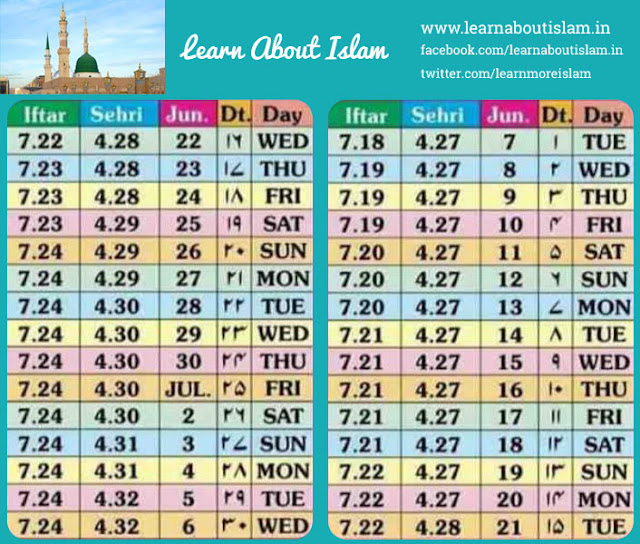
Ramadan Timetable 2016 - Ramadan Sehri and Iftar Timings

Ramadan Timetable 2016 - Ramadan Sehri and Iftar Timings

#RAMADAN TIMETABLE 2016  - MUMBAI & SURROUNDINGS

Ramadan Timetable 2016 - Ramadan Sehri and Iftar Timings 

Ramadan Timetable 2016 - Ramadan Sehri and Iftar Timings
Dua for breaking a fast

Allahumma inni laka sumtu wa bika aamantu wa 'alayka tawakkaltu wa 'ala rizq-ika aftarthu fathakabl minni

Dua for keeping a fast (Sehri)

Wa bisawmi ghaddan nawaiytu min shahri ramadan

Alternately you can also Read

Navaitu an asuma gadala lilaahi ta aalla min fardi ramadan

Monday, May 16, 2016

Shabe Barat Ki Fazilat aur Ahmiyat | The Significance of Shab-e-Baraat

Shabe Barat Ki Fazilat aur Ahmiyat | The Significance of Shab-e-Baraat


Few scholars have suggested that this night is Shabe Barat. Shabe Barat is also called Night of Forgiveness. On the night of Shabe Barat, Allah Ta’ala Forgives all his servants on this earth.

On 13th Night, Jibrail Alahisalam comes to Prophet Muhammad Sallahu Alaihi wasalam and informs that Allah has given Rights to forgive 1/3rd of the people from his Ummat.

Allah's Messenger asks what about others. Jibrail Alahisalam says He doesn't know.

On 14th Night Jibrail Alahisalam comes to Prophet Muhammad Sallahu Alaihi wasalam and informs that Allah has given Rights to forgive 2/3rd of the people from his Ummat.

Allah's Messenger again asks what about others. Jibrail Alahisalam replies He doesn't know.

And finally on 15th Night Jibrail Alahisalam comes to Prophet Muhammad Sallahu Alaihi wasalam and informs that Allah has given Rights to forgive 2/3rd of the people from his Ummat.

So on this Night, The power to forgive his Ummat is given to our beloved Prophet Muhammad Sallahu Alaihi wasalam

Shabe Barat has four names

1) Laylatul Baraat
2) Laylatul Rahmat
3) Laylatul Mubarak
4) Laylatul Sakr

There are many merits of Shabaan, especially the 15th of Shabaan, which is known as Shab-e-Baraat or Lailatul Baraat, meaning the Night of Absolution.

Shab-e-Baraat is a vessel for Mercy, Blessing, Benefit, Pardon and Forgiveness that descends upon the people of the earth. On this great night, Allah Ta’ala descends to the first heaven and proclaims, “Is there anyone who seeks forgiveness so that I may forgive him? Is there anyone who seeks sustenance so that I may grant him sustenance? Is there anyone who seeks freedom from his problems so that I may remove his problems?” This announcement continues until the break of dawn.

Rasoolullah (Sallallahu Alaihi Wasallam) has said, “On the night of the middle of Shabaan, Allah Ta’ala descends to the heaven of this lower world and forgives every Muslim, except a mushrik (one who associates partners with Allah Ta’ala), the bearer of malice, the breaker of family ties, the adulterer, the miser, the one who is disobedient to his parents and the one who consumes alcohol. He (Sallallahu Alaihi Wasallam) has also stated that during this night Allah Ta’ala opens 300 doors of Mercy unto his servants and that the slaves of Allah Ta’ala are emancipated from the fire of hell, as numerous as the hairs on the flocks of the tribe of Bani Kalb.

Allah Ta’ala states in the Holy Qur’an, “Therein all matters of wisdom are sorted out for Decree.” [Surah 44, Verse 4]. This Aayat refers to Shab-e-Baraat and it is stated in Tafseer Noorul Irfaan that on this great night, the entire year’s program of sustenance, death, life, honour and disgrace, in short every affair of man is listed from the Divine Tablet and handed over to the angels of each area on the earth in the form of a book. For example the Angel of Death is given a list of the names of those who would be dying in the coming year.

Some Ibaadaat that may be performed during this night:

After Asr Salaah the following should be recited 70 times:

Astagh Firullaha Rabbi Min Kulli Zam Bin Wa A’tubu Elaih

Just before sunset the following should be recited 40 times:

Laa Hawla Wala Quwata Illa Billa Hil Aleeyil Azeem
  1. After Maghrib Salaah 6 rakaats of Nafl Salaah should be read as three sets of two rakaats. Before the first 2 rakaats, make Dua to receive a long life through the barkat of those 2 rakaats. For the second set make Dua to be saved from all types of problems and for the third set make Dua for Allah Ta’ala not to make you needy of anyone besides Him. After each set of rakaats, recite Surah Yaseen once, Surah Ikhlaas 21 times and thereafter Dua-e-Nisfe Shabaan.
  2. One should also try to fast on the 15th of Shabaan as this is the Sunnah of Rasoolullah (Sallallahu Alaihi Wasallam). It is also better to fast both on the 14th and 15th (if possible) so that one would enter the blessed night of Shab-e-Baraat in a state of fasting.
  3. One should also try to visit the Qabarastan (graveyard) to make Dua of Maghfirat (Forgiveness) for the deceased, as this is the Sunnah of our beloved Rasool (Sallallahu Alaihi Wasallam).
Perform Ghusl after Magrib Namaz for Safeguarding from Magic for the Whole Year till next Shab E Baraat
 
On the 15th night, After Magrib Namaz, Take Ghusl with Berry Leaves. Take 7 leaves, boil them in water and perform Ghusl with that water. Each person must have 7 leaves. After Ghusl, Perform 2 Rakats of nafl for tahiyatul wudu. In every Rakaat, after the Suratul Fatiha, you should read Ayatul Kursi once and Surah Ikhlas 3 times.   
Also Read:

Sunday, May 15, 2016

All you want to know about #Zakat-ul-Fitr. FAQs of Zakat with videos

All you want to know about #Zakat-ul-Fitr. FAQs of Zakat with videos


Who must pay zakat ul Fitr? What is #Zakat-ul-Fitr and Whom to Pay Zakat? How much Zakat to pay? What is Zakat? When to pay Zakat?

#Zakat-al-Fitra FAQs
Q: What is Zakat al-Fitrah?
A: It is religious tax/alms (zakat) paid on the day when Muslims break the fasting period at the end of the month of Ramadan. This tax/alms is known as Zakat al-Fitrah.

Q: What do the Qur’an and Hadith say about Fitrah?
A: Imams (pbut) say that the verses: Indeed whosoever purifies himself shall achieve success, and glorifies the Name of his Lord and prays (87:14-15) refer to giving of Fitrah and saying prayers on Eid al-Fitr. Imam Ja’far as-Sadiq (pbuh) said: For your fast to be accepted, give zakat.

Q: When does Fitrah become wajib (obligatory)?
A: Payment of Fitrah becomes obligatory after sunset on the eve of Eid al-Fitr. The Fitrah should be kept aside and paid on Eid al-Fitr before Eid prayers or before midday for those who cannot say their Eid prayers. It is necessary to have obligatory intention (Niyyat) of giving Fitrah for God’s pleasure only.

Q: What happens if someone forgets or does not give Fitrah on time?
A: If one does not give out or set aside the Fitrah within the due time, he should give the Fitrah later, on the basis of precaution, without making the Niyyat of Adaa or Qaza but only ‘Qurbatan ila Allah.’

Q: Can we give Fitrah in advance?
A: Giving Fitrah before the eve of Eid al-Fitr is not permissible. However, if you wish to send Fitrah earlier so that it reaches the needy on time, then you can send it as a temporary loan to the needy and then change your intention from loan to Fitrah on the eve of Eid al-Fitr.

Q: To whom is Fitrah obligatory?
A: Paying Fitrah is obligatory on every Muslim who is mature (Baligh), sane, financially able, &conscious on the eve of Eid al-Fitr. Fitrah should also be paid on behalf of all dependents (e.g. wife, children) whom one supports financially.

Q: When is a host required to pay Fitrah for his guest?
A: If a person invites another person to his house on the eve of Eid al-Fitr and if the guest is present at the host’s place at the time of the sunset then it is obligatory for the host to pay Fitrah for his guest.

Q: What happens if the guest arrives after the sunset on Eid night?
A: In this case the guest will pay his/her own Fitrah and it is not obligatory on the host to pay Fitrah for the guest.

Q: What happens if a guest comes uninvited and is present at the time of the sunset on the eve of Eid al-Fitr?
A: Ayatullah Sayyid As-Sistani says that the host should still pay the Fitrah as an obligatory precaution. However, Marhum Ayatullah Sayyid al-Khui was of the opinion that is recommended for the host to pay Fitrah of an uninvited guest.

Q: How much should we pay for Fitrah?
A: Fitrah for a person is given on a weight of 5.5 pounds , which is 2.49 kg(2.5kg) on any food commodity like wheat, barley, rice, millet, raisins or dates.

Q: Can we give cash value of any commodity mentioned above?
A: Yes, cash value in lieu of any foodstuff mentioned can be given as Fitrah. Thus, if a Kilogram of rice costs Rs.18.00, the cash value of Fitrah on rice per person would be 45.00. (Please check prices for other items in your areas.)

Q: Whom should we give the Fitrah to?
A: It is given to the needy who are unable to meet their own or their dependants annual living expenses, nor do they have the means to do so through earning.

Q: Who should not be given the Fitrah?
A: A needy who: consumes alcohol, does not say his daily prayers (Salat), commits sins openly, or he who is known to use the Fitrah in sinful way.

Q: Are there any additional rules that we need to be aware of?
A: Following are some important rules:
(i) Fitrah should not be sent outside the town one resides in, if there are deserving Mumineen in that town.
(ii) Fitrah from a non-Sayyid cannot be given to a needy Sayyid; the reverse is permissible.
(iii) A needy should be given at least one Fitrah
(iv) Amongst the needy, relatives should be preferred over others when giving Fitrah, next in line are neighbors and then the learned.
Is wearing Taweez (Amulet) (Shirk) permissible in Islam with videoI

Is wearing Taweez (Amulet) (Shirk) permissible in Islam with videoI

Is wearing Taweez permitted in Islam? Is it Shirk to wera Taweez in Islam? Why is Taweez worn in Islam? Is there any relevance to wearing Taweez in islam? What is the status of Black Magic in Islam? And you may have may such questions on Taweez (Amulet)

We bring you detail information on Taweez from Quran and Hadiths. We also bring you videos in for of Audio to explain better by Mufti Shahid Barkati

Video: Kya Taweez Pehana Shirk hain (Quran aur Hadees ki Roshni mein) 


What is Taweez?

The definition of a Ta’weez is simply ‘a written Du'a,’ which is from the Qur’an or Ahadith, and is for the one who cannot read or has not memorized that particular Du'a. It is written on a piece of paper and is worn around the neck.

We, the Ahle Sunnah believe, to wear a Taweez around the neck is permissible if the du’a contained in it is written from the Qur’an or Ahadith. Prophet Muhammad [May Allah bless him and grant him peace] used to recite du’a and then blew onto the sick person. The companions of the Prophet [May Allah bless him and grant Him peace] also did this and the companions wrote the du’a on a piece of paper and placed it around the neck of that person if they could not read it. Of course, the du’as from the Qur’an and Ahadith have the power to heal the sick. Some people say, if you wear the Taweez you are commiting shirk, but we will prove, with the help of Allah Almighty, that it is permissible to wear a Taweez.

Proof of Taweez from Quran

The Qur’an has the power of healing

Allah Almighty says in the Qur’an,

“…We send down in Qur’an that which is a healing and a mercy to the believers…”

(Surah Bani Israeel Verse 82).

Qadi Shawkani writes, if the Qur’an’s du’as are recited and blown on the sick, they will be cured. When the non-believers recite the Qur’an, their blasphemic disease will be cured. (Tafsir Fathul Qadir under Verse 82 Surah Bani Israeel).

Proof of wearing the Taweez

1) Hafidhh ibn Kathir and Qadi Shawkani writes:

Amr Ibn Shu’aib RadhiAllahu ‘anhu says, that ‘RasoolAllah (Sallallahu’ alaihi wa sallam) taught my Father and grandFather a Du'a which we would read before going to sleep, to protect us from fear and anguish. We told our elder children to recite this Du'a before going to sleep as well. But for those children who were not yet literate, we would write it and then put it around their necks.

[Musnad Ahmad Ibn Hanbal vol.2, Abu Dawud in Chapter of Medicine, Tafsir by Hafidhh Ibn Kathir of verse 97 of Surah Al-Mu’minoon and Qadi Shawkaani in Fath-ul-Qadeer under the same verse]

It is permissible to read du’a and blow upon the sick

2) Imam Bukhari and Imam Muslim writes:

When a person who was sick or in some distress they would go to the Prophet [May Allah bless him and grant Him peace] who would then place his hand on the area of the pain and recite a du’a and then blow onto him.
(Bukhari, Muslim chap on Tibb).

3) Imam Muslim writes: 

When the Prophet [May Allah bless him and grant Him peace] was ill for the last time, angel Jibreel [May Allah bless him and grant Him peace] came and recited du’a and blew on to the Prophet [May Allah bless him and grant Him peace]. (Muslim chapter on Tibb)

4) Imam Muslim writes:

Aisha (Radiall hu anhua) said when the Prophet [May Allah bless him and grant Him peace] was ill the last time, she recited Surah Al-Falaq and Surah Al-Naas and then blew on to the Prophet [May Allah bless him and grant Him peace]’s hands. The Prophet then blew this onto his own face and body because his hands had more blessing then Aisha’s (Radiall hu anha).

(Muslim chap on Tibb)

From the above narrations, it proves that to blow after reciting du’as onto the sick is Sunnah and the more pious the person is, the more healing power he has because he is blessed more than the less pious. 

5) Hafidhh ibn Taymiyyah writes:

It is permissible to [to recite du’as, and then] blow upon the sick in Islam, but the words must be from the Qur’an or Ahadith. If the words are not then it is not permissible.
[Al-Tawasul chapter on Blowing onto the Sick by Hafidh ibn Taymiyyah]

FAQS of wearing Taweez

Q) Some people say, “How is it allowed to blow dua’s onto the sick, when some Hadith say this is forbidden?” 

Allama Sa’idi has written the answer to this question in great detail he’s also put the opinion of all the other great scholars, and we will present this here.

Allama Gulam Rasool Sa’idi writes:

Imam Nawawi Rahmatullah in Sharh Muslim states: ‘there are two types of Ahadith concerning blowing. (Reciting a Du'a and then blowing onto a person.) One of the types is transmitted in Bukhari: ‘There will be people who will enter Paradise without any questioning, who have never been blown upon’. Imam Muslim Rahmatullah has also written a hadith in support of those who do not ask to be blown upon. Imam Bukhari Rahmatullah in the chapter on Tibb (Medicine) has written Du'as, which our Prophet [May Allah bless Him and grant Him peace] recited when doing ‘Damm’ (Reciting a Du'a and then blowing onto a person). Imam Muslim Rahmatullah states in the Chapter on Virtues of the Prophet [May Allah bless Him and grant Him peace] that: when our Prophet [May Allah bless Him and grant Him peace] was ill, the Angel Jibreel came to him and performed the blowing. The above types of Ahadith apparently seem to contradict each other but in reality there is no contradiction.

The former type of Hadith refers to the prohobition of having read something that is not from the Qur’an and Sunnah [ie, something that has pictures, diagrams and words not from the Qur’an] and then blow upon someone. The latter types of Ahadith which permit Damm refer to those Kalimaat (words or verses) which have been taught by the Prophet [May Allah bless Him and grant Him peace]. In the same way as above there are two types of Ahadith concerning Ta’weez. There are many narrations that forbid the use of Ta’weez and also many permitting their use. Imam Qurtubi Rahmatullah wrote in detail about both types of Ahadith concerning Ta'weez: ‘The Ta’weez that are forbidden are those Ta’weez from the time of ignorance, those which are Satanic and contain an element of Shirk'. (Mantar, Voodoo and Magic etc.) The Ta’weez, which are permitted are those written with Du'as, which are evident from Qur’an and Ahadith only. Here are the narrations, which show that it is permitted for a person to put a Ta’weez around his/her neck.

Allama Alusi Hanafi in his Tafsir of the Qur’an writes: According to Imam Malik Rahmatullah ‘It is permitted to put around the neck the Ta’weez written with the name of Allah? Imam Baqir also stated that it is permitted to put such a Ta’weez around the neck of a child. [Rooh-ul-Ma’ani, chapter 15" under verse 97 of Surah Mu'minoon]

Allama Shami Hanafi Rahmatullah writes: 

It is permitted to write a Ta’weez and put it around the neck. He further adds that it would be better if a person recites the Du'as taught by the Prophet (Sallallahu’ alaihi wa sallam.) But if a person cannot read or is too young to recite then it is permitted for that person to put it around the neck
[Rud-ul-Mukhtar chapter Qirat, Sharah Sahih Muslim chapter on Tib by Allama Sa’idi].

To conclude it can be said that those verses that oppose the Qur’an, Shari’ah, or the Sunnah are forbidden to read and also forbidden to put around the neck. But as for the Du'as and verses from the Qur’an and Sunnah it is permitted to be written and put around the neck of a small child or an illiterate or a sick person.


Post your Comments

#Islamic Calendar 2025 Events

Islamic 2025 Event Name English Date Islamic Date
Urs Haji Malang January 2, 2025 - Thursday 10 Jumada al-Akhirah 1446
Urs Haji Ali Baba Mumbai January 4, 2025 - Saturday 12 Jumada al-Akhirah 1446
721st Urs Sharif Of Hazrat Khwaja Syed Nizamuddin Aulia Mehboob-e-Elahi Rahmatullah Alayh January 7, 2025 - Tuesday 15 Jumada al-Akhirah 1446
Urs Khwaja Gharib Nawaz, Ajmer Sharif March 24, 2025 - Monday 22 Sha'ban 1446
Lailat al-Miraj (Shab-e-Meraj) January 27, 2025 - Monday 27 Rajab 1446
Shab-e-Barat February 14, 2025 - Friday 15 Sha'ban 1446
Start of Fasting Month (Ramadan) March 1, 2025 - Saturday 1 Ramadan 1446
Lailat al-Qadr (Shab-e-Qadr) March 27, 2025 - Thursday 27 Ramadan 1446
Jummat-ul-Wida March 28, 2025 - Friday 28 Ramadan 1446
Eid-ul-Fitr March 30, 2025 - Sunday 1 Shawwal 1446
#Hajj June 6, 2025 - Friday 9 Dhul-Hijjah 1446
Eid-ul-Adha (Bakrid) June 7, 2025 - Saturday 10 Dhul-Hijjah 1446
Islamic New Year July 28, 2025 - Monday 1 Muharram 1447
Yaum al-Ashura August 6, 2025 - Wednesday 10 Muharram 1447
Eid Milad-un-Nabi September 26, 2025 - Friday 12 Rabi-al-Awwal 1447